Each stage below carries its own cost and lead time. Then there are the three mistakes that cost first-time buyers the most money. We have been coordinating apparel production in Guangzhou since 2015, and the numbers on this page are the ones we quote to buyers — not industry averages.
How Many Steps Are in Custom Apparel Development, and How Long Does Sampling Take?
Five steps, and sampling takes 7–14 days once the tech pack and fabric are locked.
Each step has an input, an output, and a decision that only you can make.
- Tech pack confirmed. You send the style drawing, the size chart, fabric and color references, print or embroidery placement, the trim list, and packaging requirements. What comes back is one spec sheet that both sides sign. Your decision: measurements, logo version, packaging.
- Fabric and trims locked. Either you nominate a fabric or we match a stock one to your target price. Nothing gets ordered until the color and every trim are confirmed in writing. Your decision: which fabric, which trims.
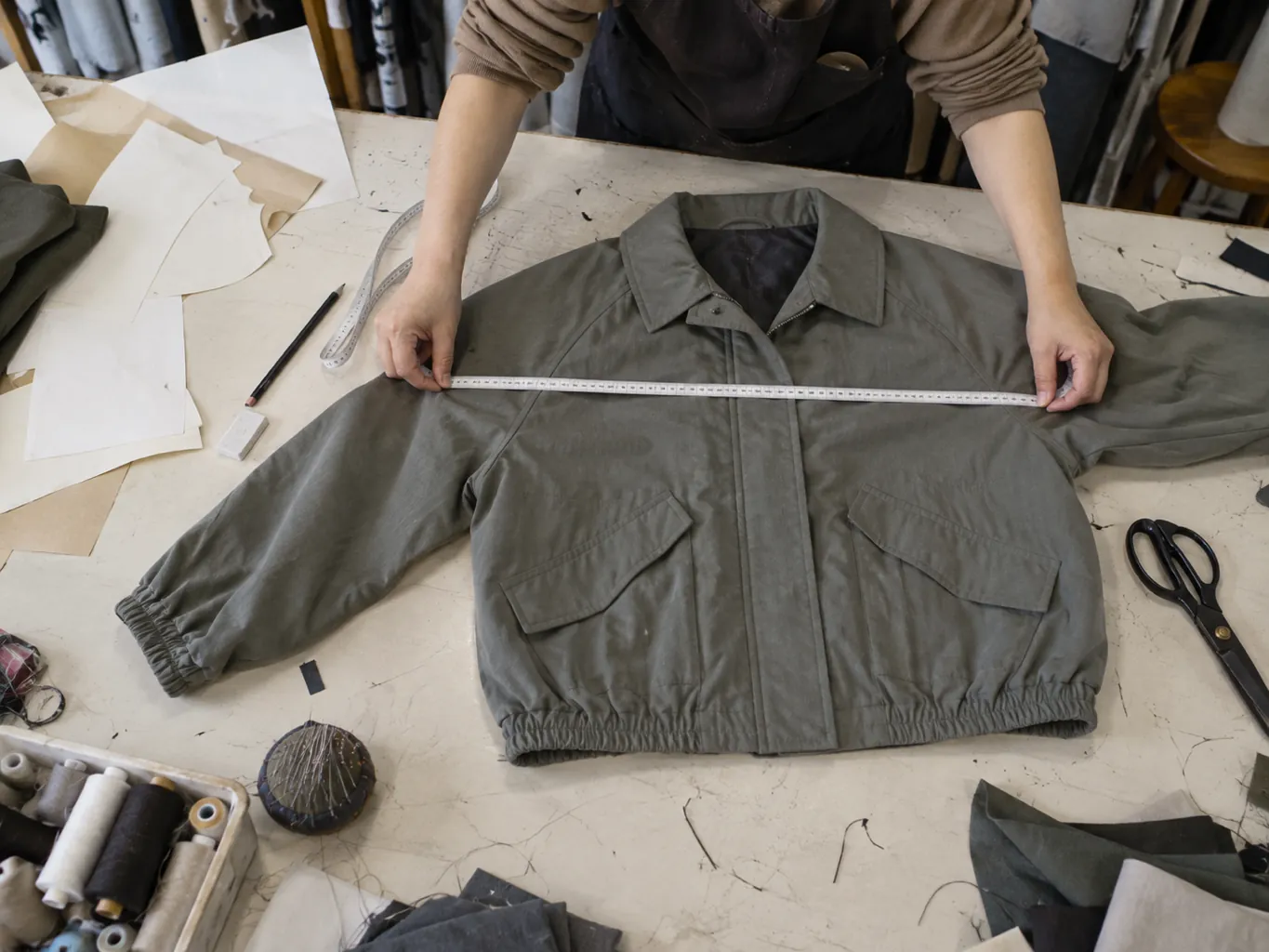
- Pattern made. The patternmaker builds the block from the confirmed size chart and construction details. This step decides whether the sample fits; it is also where a thin size chart shows up as a bad shoulder or a twisted side seam.
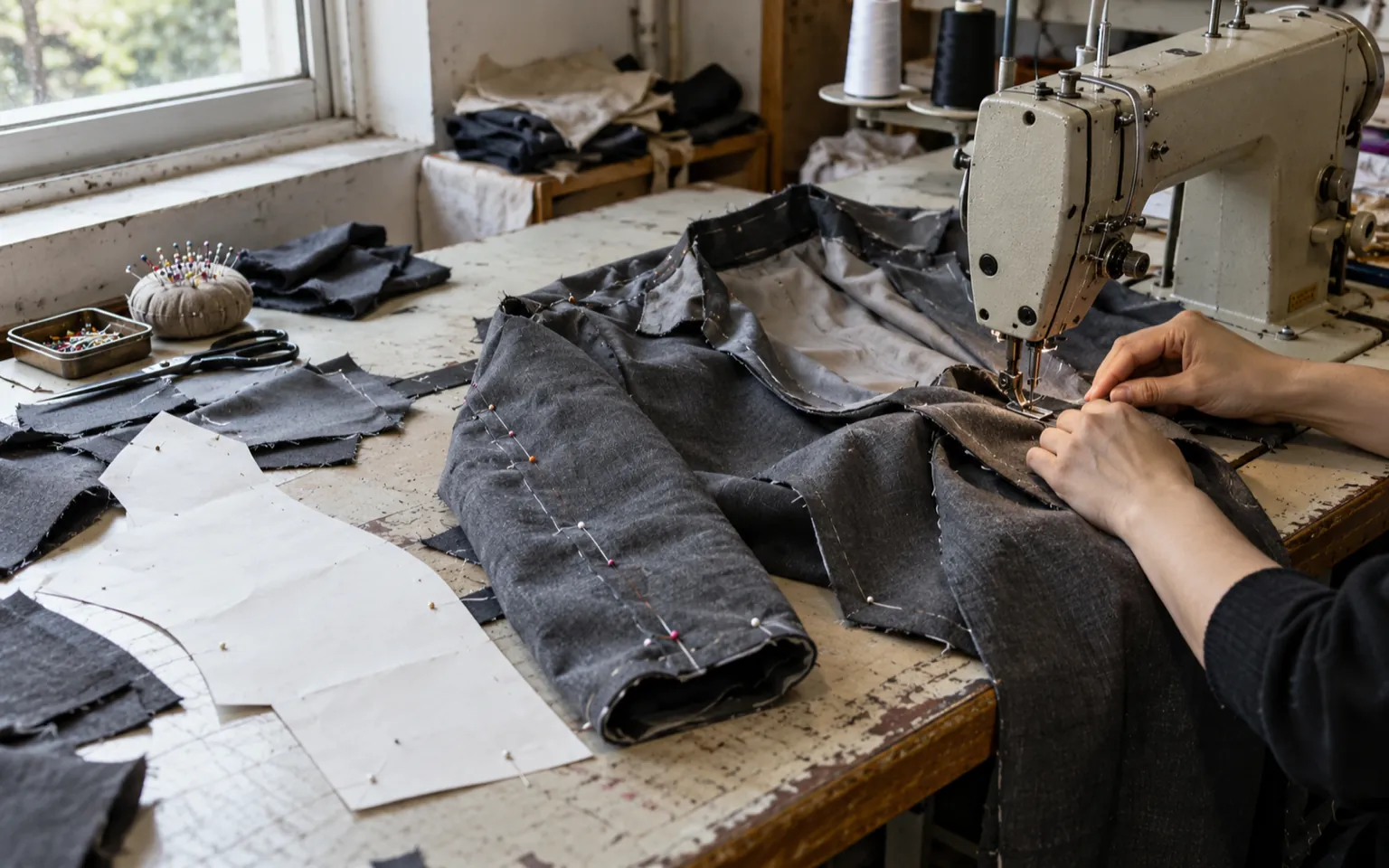
- Sample sewn. The sampling room sews your piece using the actual trims, so what you receive is what bulk will be, not a cleaner version of it.
- Sample shipped and fitted. You try it on a fit model, mark the comments, and approve or ask for changes. Approval here is the gate to bulk production — nothing goes into production before it.
Sampling and bulk run on two different clocks. Sampling is 7–14 days. Bulk production runs 30–45 days after the sample is approved. If your launch date is fixed, plan backwards from the bulk window, not from the sampling window.
A typical run from first email to sample in hand looks like this:
| Stage | Who moves it | Time |
|---|---|---|
| Inquiry answered with a quote | Us | within 1 business day |
| Sampling slot booked | Us | When you confirm the sampling order |
| Tech pack and fabric locked | You, mostly | Depends on how fast you approve — the clock does not start without it |
| Pattern made | Us | Industry-wide, pattern development through first sample runs 1–3 weeks |
| Sample sewn | Us | Industry-wide, a first sample typically sews in about 5–10 days once materials are in |
| Sample delivered to you | Courier | Express courier from Guangzhou typically 1–5 business days |
| Sampling total, specs to sample shipped | — | 7–14 days |
| Bulk production after approval | Us | 30–45 days |
Day counts for the individual steps inside the 7–14 days: we quote the total, not a per-step split — where the time goes shifts with the style and the fabric.
Three of the five steps end with a decision only you can make, and those are the ones buyers underestimate. The factory cannot guess your logo version, and it cannot approve your fit. Nothing moves while an approval sits in someone's inbox, and that delay lands on your launch date, not ours.
What Do I Need to Prepare Before Sampling? Can I Start Without a Tech Pack?
A tech pack needs seven things: drawing, size chart, fabric, color, logo, trims, packaging.
| Item | What we need from you | Locked before sampling? |
|---|---|---|
| Style drawing | Front and back views, seams, stitch types, finish | Yes |
| Size chart | Points of measure, tolerances, size grading | Yes |
| Fabric | Composition, weight in GSM, hand feel, color reference | Yes |
| Color | Pantone TCX code, or a physical swatch mailed to us | Yes |
| Print or embroidery | Vector artwork, placement, size, colors, and the exact logo version | Yes |
| Trims | Zipper, buttons, woven label, care label, drawcord | Yes |
| Packaging | Poly bag or zipper bag, hang tag, sticker, carton mark | Yes — this is the one buyers postpone and regret |
A few items can follow later: care-label legal text for your market, carton marks, retail barcodes, and shipping documents. Settle them before bulk production, not before sampling. None of them change the shape of the garment.
The rest cannot wait, and the cost of a gap is concrete. A size chart without tolerances turns into a pattern that has to be rebuilt. A logo file sent in the wrong version turns into a sample — and then a bulk order — carrying an older mark than the one on your website. Packaging added late turns into a second sample and a second courier bill. Every one of those adds a fresh round of sample fee and freight on top of the 7–14 days you already spent.
If all you have is a sketch or a reference sample you bought elsewhere, that is a conversation worth having early — send it with your inquiry and we will tell you what else we need before a sampling slot can open.
Before we open a sampling slot, we ask buyers to confirm this list in writing:
- The spec sheet, signed or replied "approved" in the thread
- Size chart with tolerances, not just a single size
- The logo version, dated, so nobody has to guess later
- The trim list, closed — no "we'll decide the zipper later"
- Packaging: a sample or a clear photo of what you want
- Your target launch date, so we can flag a clash with peak season
Who Sources the Fabric and Trims, and When Do They Need to Be Locked?
You nominate the fabric, or we match a stock one to your target price and deadline.
Both routes work. They carry different lead times and different minimums.
| Route | What you provide | What it means |
|---|---|---|
| You nominate the fabric | Mill name or swatch, composition, weight, color reference | Mill lead time and mill minimums apply; you own the risk if the mill slips |
| We recommend stock fabric | Target price, hand feel, color direction, end use | Faster, lower minimums, and usually the better first run for a new brand |
Fabric that is already in stock and in the right color is the single biggest lever on sampling speed. Fabric that has to be knitted or dyed to a Pantone code adds mill time before our 7–14 days even begins. Industry planning guides put fabric confirmation 90–120 days ahead of the target ship date, and custom fabric production alone can run 25–45 days or more.
For a first development, we push buyers toward stock fabric. The reason is simple: it lets you see the fit and the finishing on a real sample before you commit to a mill minimum you may not want to hit twice.
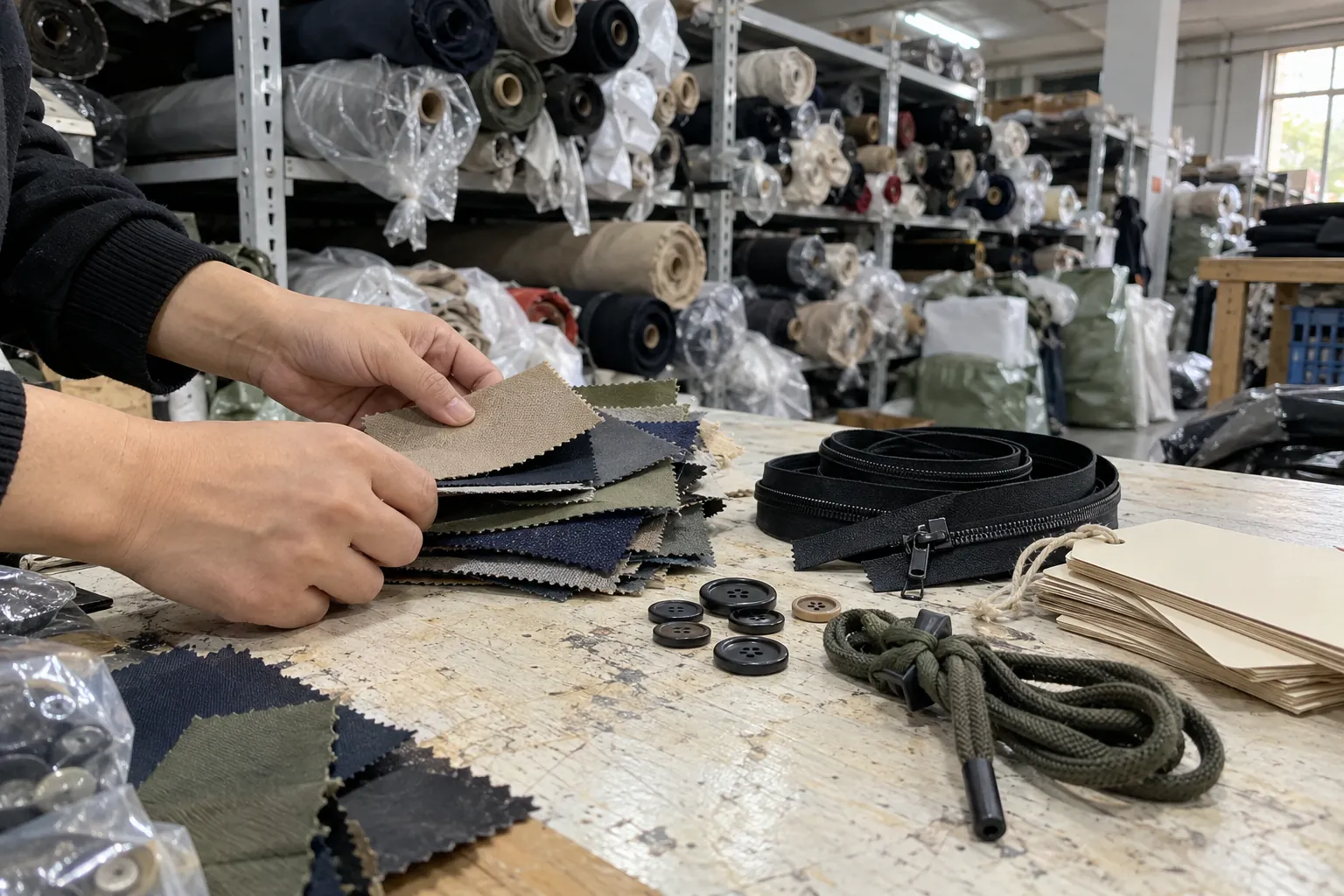
Trims deserve more attention than they get. Zippers, buttons, woven labels, care labels, drawcords, hang tags and packaging bags are all separate purchases from separate suppliers, and they are the items that quietly stretch a sampling schedule. A custom zipper bag is not a two-day purchase — in the case below it took 3–4 weeks, and that single detail changed how an order shipped.
Fabric and trim minimums vary by mill and by supplier, and we do not publish minimums we have not confirmed. What is public industry-wide: factories buy fabric by the roll — often hundreds of meters — and apparel MOQs of roughly 50–100 units per style and color are typical when stock fabric is used.
Until the fabric and the trims are locked, the 7–14 day sampling period has not started.
Waiting on a zipper is not "inside the sampling time".
What Do Sampling and Bulk Production Actually Cost?
Sample fees are 50–150 USD per piece: T-shirts and hoodies low, suits and shirts high.
The sample fee pays for one-off work — the pattern, the materials for a single piece, the sampling room's time — so it is quoted per piece rather than as a product price. A T-shirt and a hoodie land at the lower end of the range, a blazer or a dress shirt at the upper end, because the construction is slower and the pattern work is heavier. If you want a second colorway or a second size to look at, expect the fee to apply to each piece. When the sample fee is charged: ask when you request the sampling quote, so the cash outlay is clear before you commit.
Bulk unit prices depend on four things: the style, the fabric, the trims, and the quantity. Prices in this article are quoted FOB Guangzhou; tell us if you need a different Incoterm so the comparison is clean. Our confirmed bulk price ranges per category:
- T-shirt, 100–300 pieces: quoted per order — the fabric, trims and construction move the number too much to publish a range
- Hoodie or sweatshirt, 100–300 pieces: quoted per order — the fabric, trims and construction move the number too much to publish a range
- Dress, 100–300 pieces: quoted per order — the fabric, trims and construction move the number too much to publish a range
- Suit or blazer, 100–300 pieces: quoted per order — the fabric, trims and construction move the number too much to publish a range
- Quantity ladder, 100 vs 500 vs 1,000 pieces: quoted per order — the spread depends on the style, so ask with your tech pack
Then there are the fees most factories never mention until the invoice:
- Pattern fee — charged once per style when the pattern is developed: amount varies by style — ask with your sampling quote
- Print or embroidery plate / screen fee — charged per design, per color, every time the artwork changes: amount varies by design — ask with your sampling quote
- Tech pack drafting — if you only have a sketch and we draft the spec for you: quoted case by case, depending on how much of the pack needs drafting
- Inspection — 100–200 USD per inspector per day for a third-party final inspection
- Freight — quoted separately by mode; it never sits inside the unit price
- Sample fee against the bulk order — whether the sample fee is deducted or refunded when the bulk order is placed: ask when you place the sampling order, and get the answer in writing
A 100-piece order costs more per piece than a 1,000-piece order, and it is not a markup trick.
The pattern, the sample and the production setup are the same work whether you order 100 pieces or 1,000, so on a small run that work is spread across fewer units. Add the machine changeover, the minimum packs of thread and labels, and the per-unit packing time, and the gap is arithmetic.
That is why comparing headline prices without the inclusions is a waste of a week. When you read two quotes, check what is inside the number: fabric and trims, packaging, inspection, courier, and how long the price holds. A quote that is 2 USD cheaper per piece but excludes packaging and inspection is not cheaper.
Will Sampling Run Late? How Many Revision Rounds Are Included, and What Does a Re-sample Cost?
Sampling runs 7–14 days once specs and fabric are locked; revisions are what stretch it.
The 7–14 days is our normal range, and we count it from the day the tech pack and the fabric are confirmed — not from the day you first emailed us. Buyers who measure from the first email usually conclude that sampling ran late, when what actually happened was a week of unconfirmed specs before the clock started.
The variables that push a sample past two weeks are predictable:
- Fabric is not in stock and the mill has to produce or dye it
- Print or embroidery is complex, or the artwork arrives as a low-resolution file and has to be redrawn
- Trims are not decided, so the sample room sews with stand-ins and the sample has to be repeated
- Feedback comes in several rounds instead of one, each round costing production time
- Peak season, when every sampling room in Guangzhou is booked
Feedback discipline is free and it saves the most time. Try the sample on, then send all comments in one pass: pin the photos to the exact spot, name the point of measure you want changed, and say what the current measurement is against your size chart. Revision notes that arrive one at a time — "also, the sleeve" three days later — restart the sample room's queue every time.
Our revision rules: the included rounds and the re-sample charge are confirmed in writing before sampling starts — never assume revisions are free.
On timing, one piece of advice that costs nothing: put buffer in front of a fixed launch date. Peak production months and the Lunar New Year period tighten sampling slots and shipping, and a two-week sampling window in a quiet month is not the same as a two-week window in a busy one. If your launch is immovable, share the date at inquiry so we can say honestly whether the schedule fits.
Will a Factory Take a 100–500 Piece Order? How Do I Check MOQ and Capacity?
Yes — our MOQ is 100 pieces, and most first orders we run are 100–500 pieces.
Our standard minimum order quantity is 100 pieces. If your order carries a real requirement — a size curve, a fabric commitment, a repeat program — we can be flexible on it; ask, and you get a straight answer instead of a range of "maybe".
Small orders of 100–500 pieces are normal work for us, and the buyers placing them are often e-commerce brands building a first collection. When the marketing works and the style sells, the repeat orders we see move into the thousands, and sometimes into five figures of units.
Capacity matters more than MOQ, because capacity decides whether your reorder is possible. Our monthly capacity runs at:
- T-shirts and hoodies: 30,000–50,000 units per month
- Dresses, suits and more complex styles: 10,000–20,000 units per month
Those two numbers are the ones to compare against your own forecast. If you plan to sell 2,000 hoodies a month by month three and the factory you are talking to can only produce 3,000 units a month in total, your reorder will queue behind every other client.
One caveat on small runs: a 100–500 piece order is best served by stock fabric, and its production slot may shift around larger clients' bookings. Plan for it, and neither is a problem. Promise your customers a ship date that assumes a small order gets priority it does not have, and both become problems.
How Do I Tell Whether a Chinese Factory's Sampling Is Actually Reliable?
Four checks: who makes the pattern, capacity fit, cost advice, and the certificate's owner.
Check 1: who makes the pattern, and who follows the sample.
Ask whether the pattern is made in the factory's own sampling room or sent out to a third-party pattern studio. Outsourced pattern work splits the communication: your fit comments pass through one more pair of hands, and the correction round gets longer. Ask for the name of the person who follows your sample from pattern to courier.
Check 2: does capacity match your category.
A factory that sews 40,000 T-shirts a month is a good partner for T-shirts and a poor one for structured blazers. Compare the capacity figures in the section above with your product and your forecast — and ask for numbers, not adjectives.
Check 3: will they challenge your construction and cost.
A sampling team that only sews what is drawn will deliver exactly the sample you asked for, including the expensive seam you did not need. The useful answer sounds like: "this placket can be simplified, it saves a step and does not change the look." Ask what they would change.
Check 4: whose name is on the certificate.
This is the question buyers skip. Certifications belong to a legal entity. We hold a BSCI certificate under our partner factories' names — it is not issued to Canton Fashion itself, and we say so plainly rather than implying otherwise. Apply the same test to every factory you shortlist: ask for the certificate, read the company name on it, and check that it matches the entity you are paying.
Our own setup, and the same test applies. Canton Fashion was founded in 2015 in Guangzhou and coordinates a network of partner factories. That model works well for small runs, and it is also why the paperwork question above matters — the company named on the certificate and the company coordinating your order are not always the same. Someone on our side answers your inquiry, and our response commitment is usually within one business day. Ask in that first exchange who follows your sample through each stage — you should always have a named contact.
Copy this list into your first email to any factory:
- How many working days for a sample, counted from which event?
- Who makes the pattern, and is it done in-house?
- What is your monthly capacity for my product category?
- What would you change in my construction to reduce cost?
- How many revision rounds are included, and what does a re-sample cost?
- Whose company name is on your audit certificate?
- What is the MOQ, and what is the sample fee per piece?
First Time Working With a Chinese Factory — What Are the Three Most Common Mistakes?
Bulk before sample approval, no agreed inspection standard, packaging confirmed too late.
Mistake 1: pushing to bulk before the sample is confirmed.
A buyer did not confirm the sample and pushed for production to start. The factory ran bulk with the logo file it had on hand — an older version than the buyer's final artwork. It was not a quality defect; the stitch and the fabric were fine. But the logo on the garments did not match the logo on the brand's website, and that difference is visible to every customer who compares the two. The rule this breaks is step 5 above: sample approval is a written gate, and the artwork attached to that approval is the artwork bulk must use.
Mistake 2: never agreeing the inspection standard.
Our production is consumer-grade, not luxury-grade, and one buyer never discussed what "passing" meant. At final inspection the goods were judged against a much stricter personal standard — points came up that most inspectors would not flag — and the order could not move forward as planned. Under the standard consumer-goods inspection levels — AQL 2.5 for major defects, 4.0 for minor ones — the same batch would have passed. The fix takes one line in the order: agree the inspection standard and the AQL levels before production, not at the loading dock.
Mistake 3: confirming packaging at shipping time.
One client, Ann Lin, confirmed her order without confirming the packaging. By the time she asked for a custom zipper bag, the order was ready to ship — and zipper bags take 3–4 weeks to produce. There was no time left, so the goods went out in plain transparent bags with no logo. The garments were fine; the packaging was not what she had planned to ship. The fix is step 2 of the tech pack list: packaging is confirmed with the order, together with hang tags and every other trim.
All three cases come down to the same habit. The steps buyers skip are not the factory's steps — they are the approval steps. Written sample approval, a written inspection standard, and packaging locked at order confirmation would have prevented all three.
How Do Payment and Inspection Work? What If the Goods Aren't Right?
New clients pay 30% deposit, inspect before shipment, then clear the balance before shipping.
The payment sequence is deliberately simple. A new client pays a 30% deposit to start production. When the goods are finished, you inspect them — yourself, or through a third-party inspection company — and the balance is paid before the goods leave the factory. We release the shipment once the balance clears.
Repeat clients can be offered better terms. After a check through Sinosure, China's export credit insurer, we can extend balance terms of 30–60 days on subsequent orders.
Inspection costs, as we quote them:
- Third-party inspection: 100–200 USD per inspector per day
- Factory visit, informal look at the line: 100–200 USD per person per day
- Formal audit inspection: 3,000–5,000 USD, depending on the scope
For small orders we recommend a final inspection only. Pre-production inspection is not needed on a short run, and the cost is better spent on the check that happens before the balance is paid.
The balance is the buyer's strongest lever, and it is the honest answer to "what if the goods are not right".
Because the balance is settled after inspection and before shipment, anything you find is raised while the goods are still in the factory and while payment is still open. That is exactly why the inspection step should never be skipped to save 100–200 USD — and why the inspection standard and AQL levels must be written into the order. An inspection result with no agreed standard is an opinion, not a finding.
Want to Start Sampling? What's the Next Step?
Send your sketch, quantity and market — you'll get a quote and a sampling slot.
The inquiry process is short. Send us your design sketch or a reference sample photo, your target quantity, and the market you are selling into. Someone picks it up and replies, normally within one business day, with pricing questions or a quote and a sampling slot.
A first message that gets the fastest useful answer includes:
- The style, with a sketch or reference photos
- Your quantity, and whether a repeat is planned
- Fabric direction, or a target price per piece if you are open on fabric
- Logo and packaging requirements, including the logo version
- Your target launch date, so we can flag a scheduling clash early
Use the contact form on this page, or the WhatsApp button on this page if you want to send photos. Ask us which contact channel works best for your design. Send the sketch, the quantity and the market — that is enough for us to tell you what sampling looks like for your product and what it will cost.
Frequently Asked Questions
When does the sampling clock start, and how long does it run?
Sampling runs 7–14 days, counted from the day your tech pack and fabric are confirmed — not from your first email. Bulk production then runs 30–45 days after you approve the sample.
What is the minimum order, and what do I pay up front?
Our minimum order is 100 pieces, and the sample fee is 50–150 USD per piece. New clients pay a 30% deposit to start production, and the balance is due after inspection and before the goods ship.
What causes a sample to run past two weeks?
The usual causes are fabric that is not in stock and has to be produced or dyed by the mill, and trims that are still undecided. Complex print or embroidery, low-resolution artwork that has to be redrawn, feedback arriving in several rounds instead of one, and peak season can all stretch the schedule too.
How much does inspection cost, and can I skip it on a small order?
A third-party final inspection costs 100–200 USD per inspector per day, an informal factory visit costs 100–200 USD per person per day, and a formal audit runs 3,000–5,000 USD. On a small order we recommend a final inspection only, and it is not worth skipping because your balance is paid after inspection while the goods are still in the factory.
I am launching a new brand with a small first run — is that workable, and how do I compare capacity?
Yes — our MOQ is 100 pieces, and most first orders we run are 100–500 pieces. Compare your own forecast against our monthly capacity: 30,000–50,000 units for T-shirts and hoodies, and 10,000–20,000 units for dresses, suits and more complex styles.