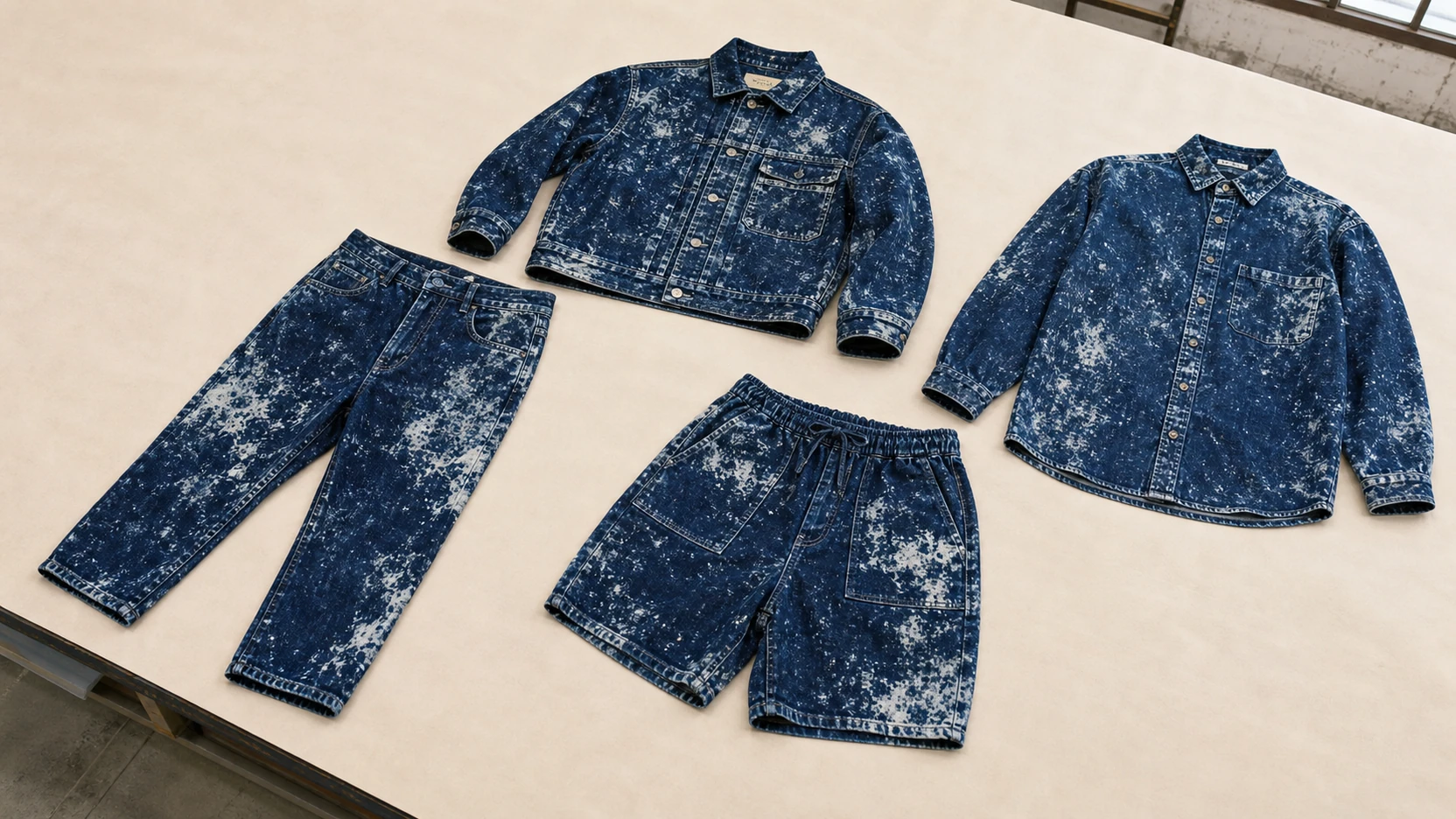
DECODE THE WASH NAME
Snow & Acid Wash
A high-contrast discharge effect is not one fixed recipe. Start with the visual range, then confirm the dye, route, neutralisation and complete-garment approval.
NAME ≠ RECIPE
What Does “Acid Wash” Actually Specify?
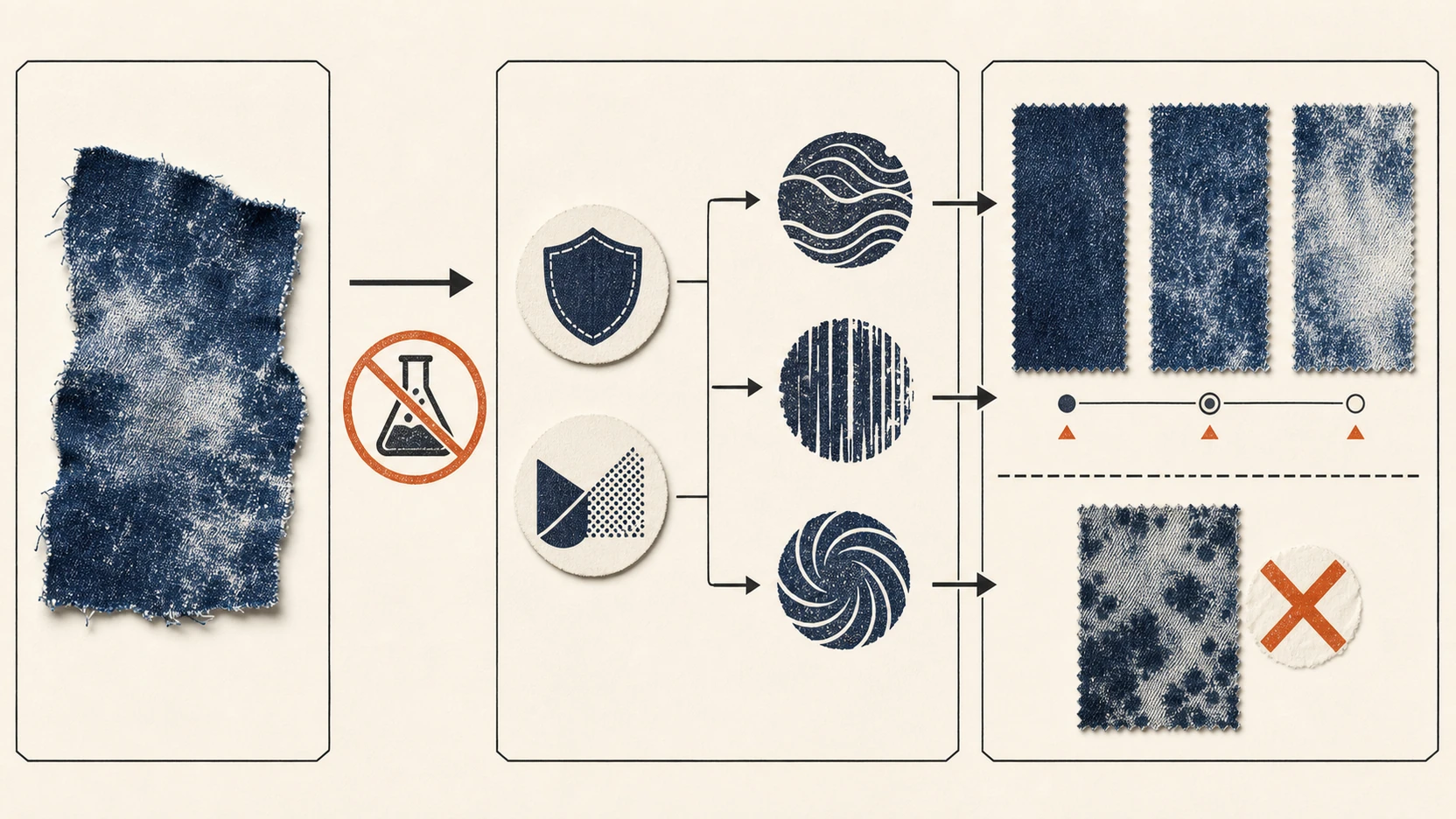
Snow, acid, ice and frosted may describe an appearance, a process tradition or a market name. None is a complete production instruction.
Acid wash is a misnomer in the established denim route. Never treat the name as permission to mix acid with bleach.
Appearance name
Describe the desired random field, contrast and placement, but do not infer chemistry.
Actual route
Record oxidiser, delivery, preparation, endpoint, neutralisation and wash-off.
Buyer approval
Approve base shade, contrast, mottle, coverage, variation and reject examples.
- Wet-finish names may describe appearance, process sequence or market identity and can be used generically or interchangeably.
- The established acid-washed denim process is called a misnomer because it uses no acid.
- Sodium hypochlorite can release toxic chlorine when it contacts acids.
BUILD THE FIELD
Turn the Reference Into Five Decisions
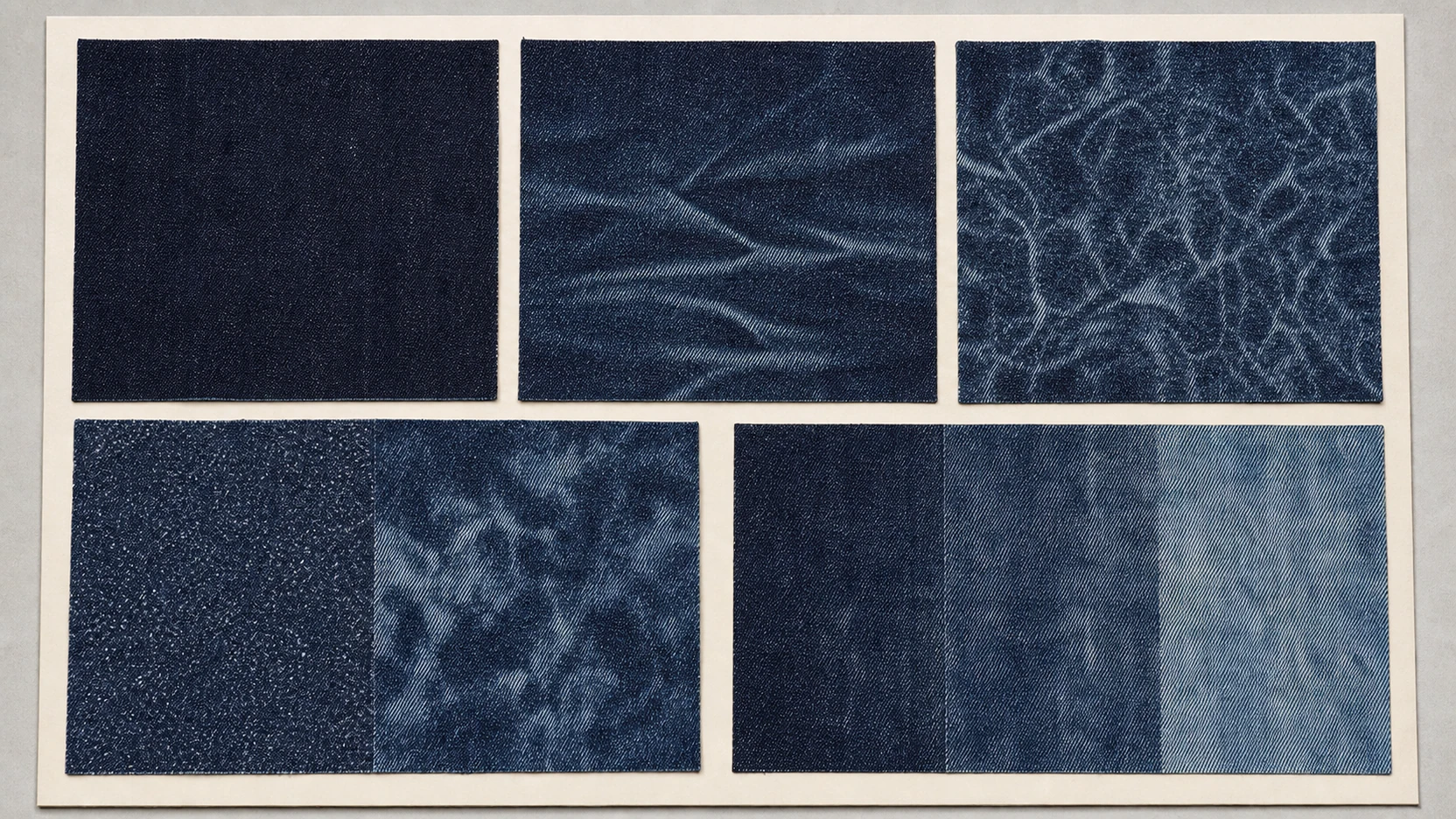
Replace “make it vintage” with a named base, contrast, mottle scale, coverage and acceptable variation band.
These levels are buyer decision language, not universal industry grades.
Base
Lock the actual untreated garment and starting shade.
Contrast
Choose restrained, medium or sharp and approve dry physical anchors.
Mottle scale
Choose fine speckle, medium cloud or a large broken field.
Coverage
Map sparse, balanced or dense treatment across front, back and inside.
Variation
Seal minimum, target, maximum and reject examples.
- Colour-discharge appearance changes with route, substrate, dye and process conditions.
- Bleach and permanganate outcomes vary with application, concentration, duration and the defined denim substrate.
- The reference must be approved as a physical effect range rather than a pixel-for-pixel promise.
CHEMISTRY × DELIVERY
Record the Chemistry and the Application Separately
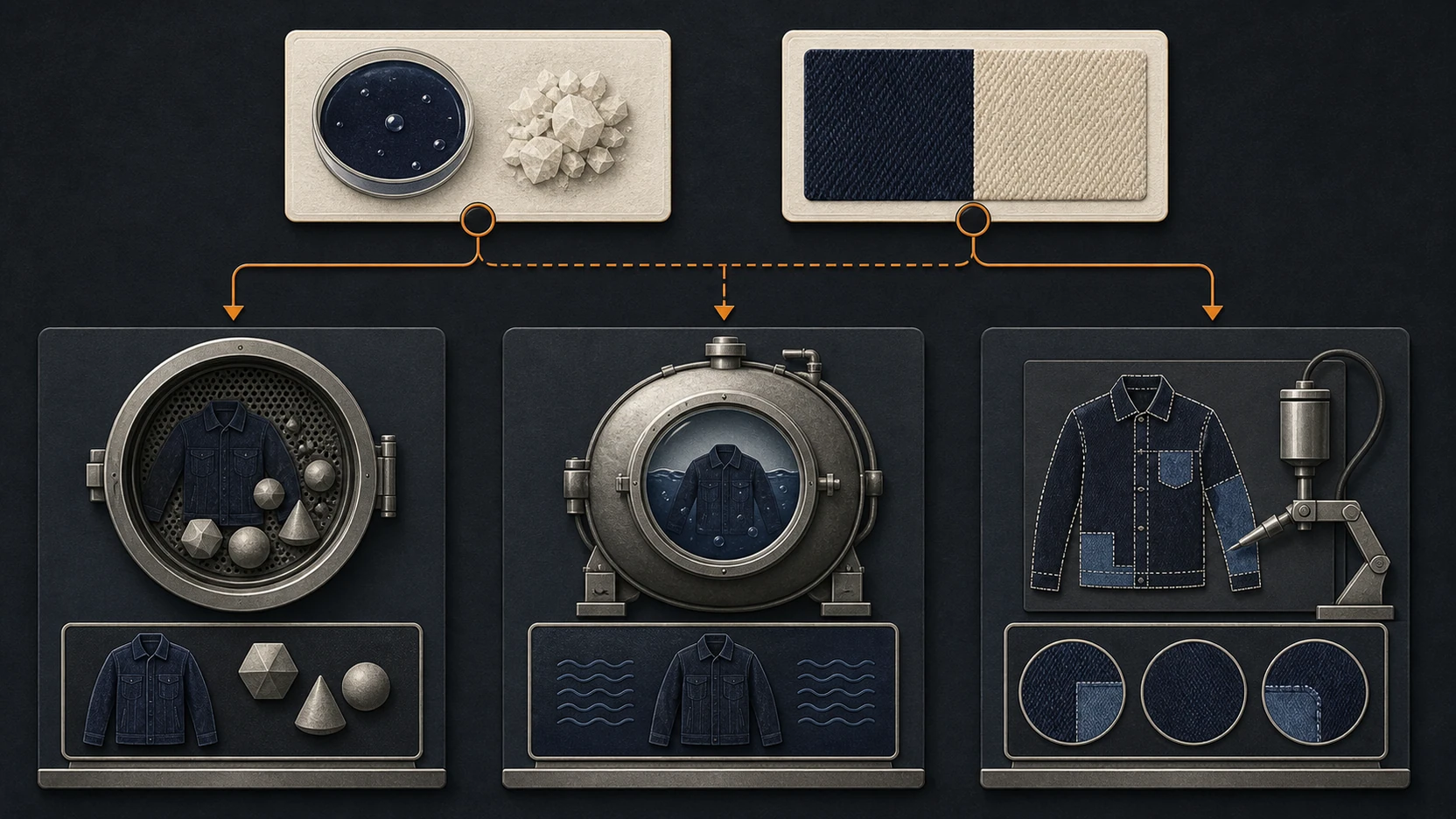
Potassium permanganate or a hypochlorite-based system identifies chemistry. Carrier-tumble, controlled wet all-over or controlled local application identifies delivery.
The three lanes are documented examples, not every possible combination and not a public recipe.
Random carrier / tumble
For a scattered all-over contact field; lock carrier, garment moisture, load, endpoint and separation.
Hypochlorite-based discharge
For route-specific bleach-down; lock product, application, anti-chlor and wash-off.
Controlled local PP
For placed highlights; lock position, edge control, masking, exposure control and neutralisation.
- CottonWorks documents carrier-tumble acid-wash routes using potassium permanganate and notes that sodium hypochlorite may be used instead.
- Hypochlorite bleach-down requires route-specific neutralisation called anti-chlor and subsequent washing.
- Potassium permanganate can be applied locally by controlled brush or spray routes, followed by neutralisation and washing.
- The processor must use the actual chemical SDS and suitable engineering controls.
WHY DENIM RESPONDS
Surface Indigo. Lighter Core. Visible High–Low.
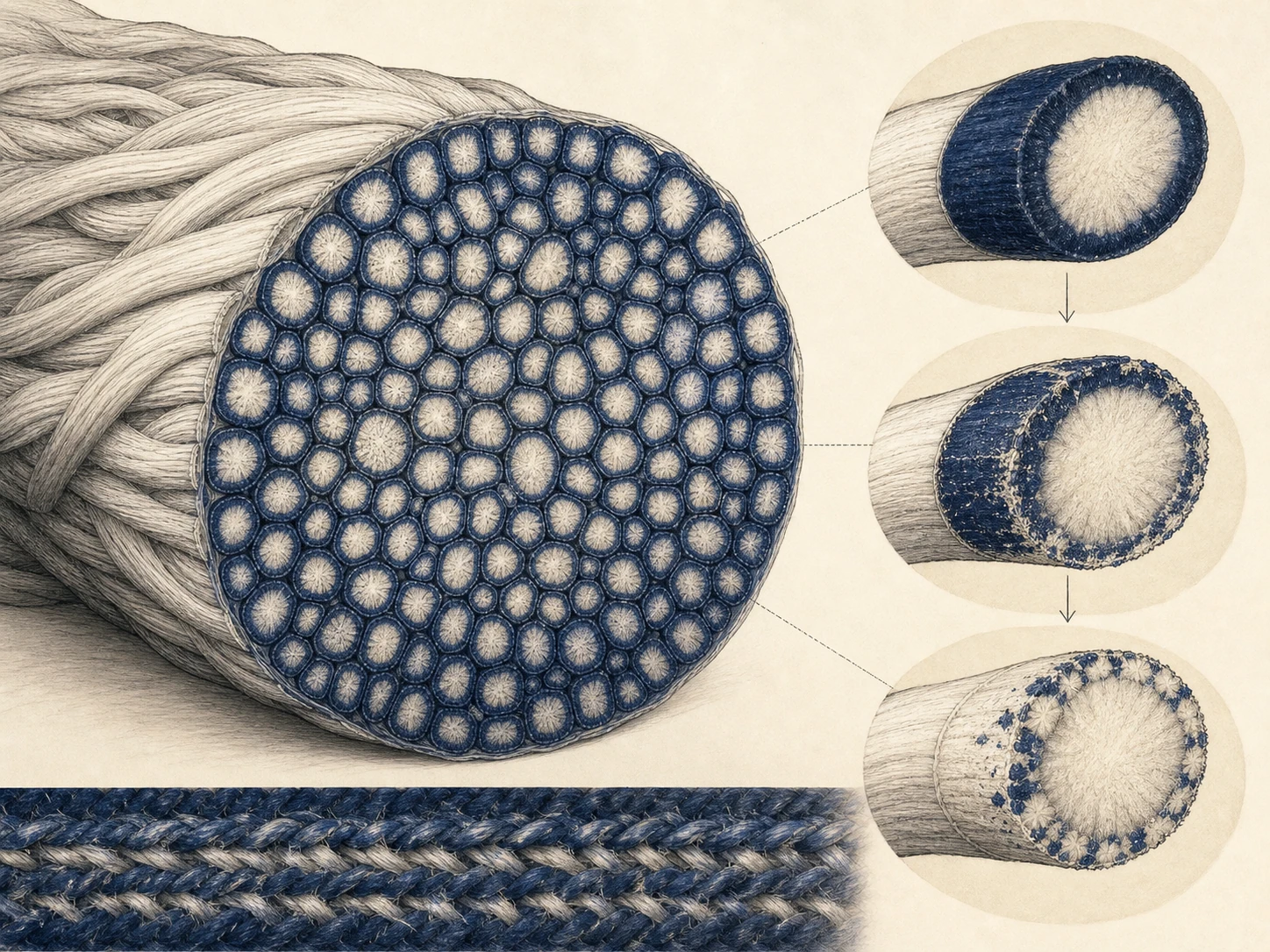
Indigo sits mainly around the outer fibre or yarn bundle and leaves a lighter inner core.
Abrasion and controlled discharge can reveal the high-low structure, but another dye or material needs its own trial.
Ring-dyed yarn
Indigo concentrates around the outside of the yarn.
Lighter core
The inside remains lighter than the surface.
Preparation
Controlled abrasion changes how much surface dye is exposed.
Discharge field
The selected route removes colour in discontinuous high-low areas.
- Indigo is a vat dye that forms a colour ring around the outer fibre or yarn bundle and leaves a lighter inner core.
- Indigo can be abraded or discharged with sodium hypochlorite or potassium permanganate.
- The ring-dye explanation does not prove the same response on through-dyed, garment-dyed, synthetic or coated material.
MATERIAL + WHOLE GARMENT
The Shell Fabric Does Not Travel Alone
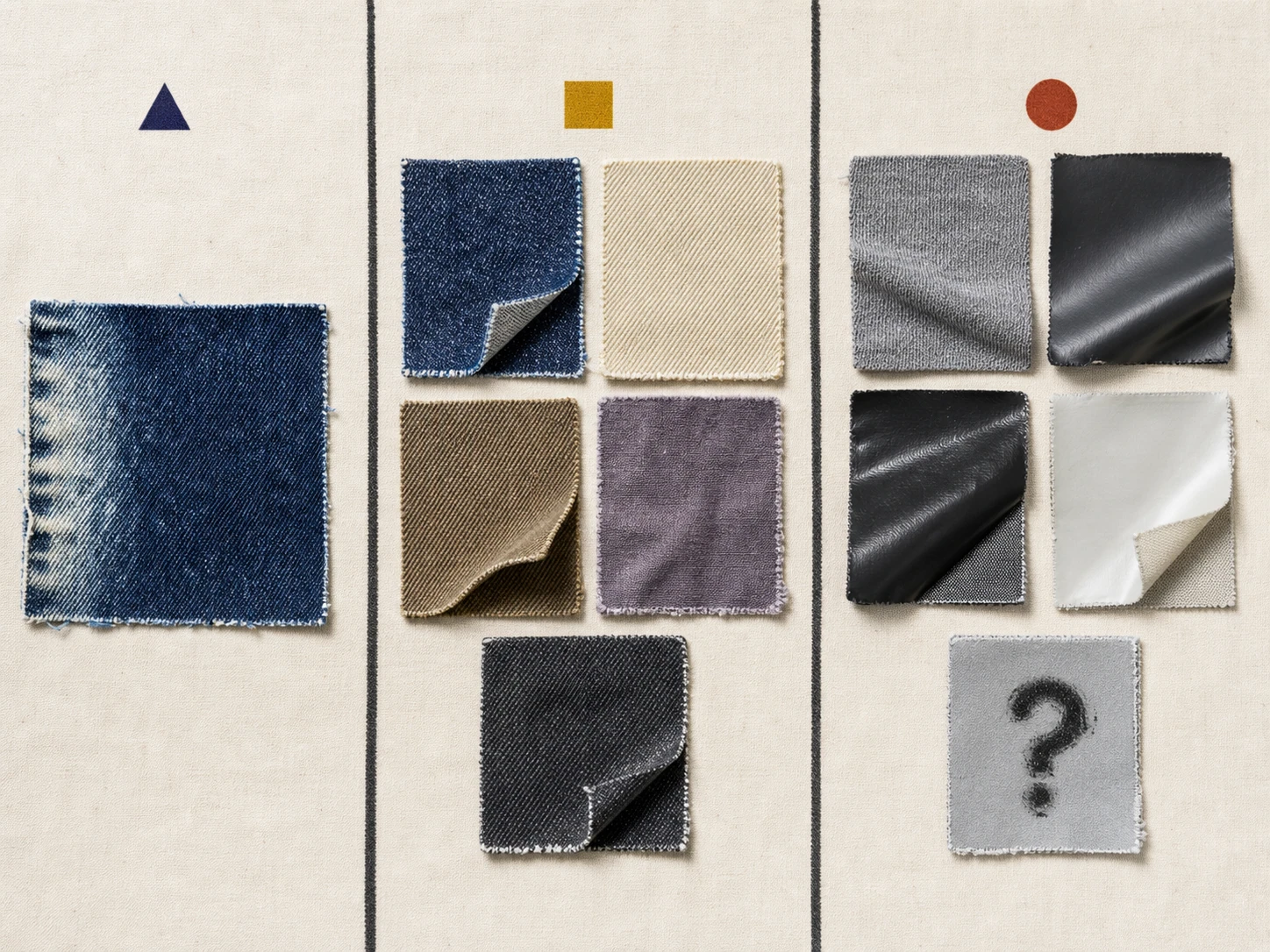
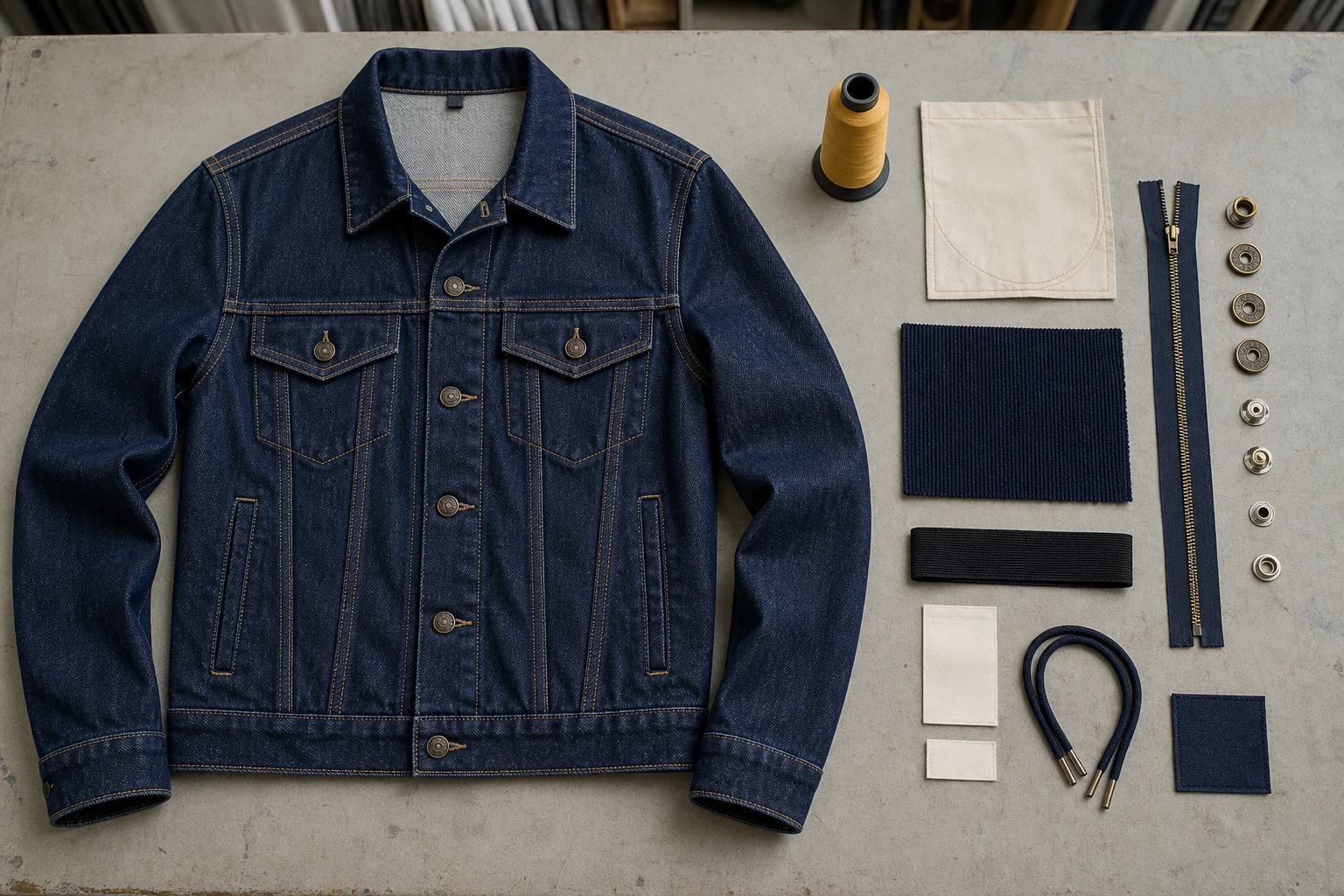
Indigo ring-dyed cotton denim is the strongest documented starting candidate. Every other material remains conditional or on hold until tested.
Thread, pocketing, rib, elastic, drawcord, zips, hardware, labels and decoration must travel through the actual complete-garment route.
Strongest starting candidate
Indigo ring-dyed 100% cotton denim, still subject to route and complete-garment trials.
Conditional
Stretch denim, cotton twill, garment-dyed cotton and cotton-rich blends.
Hold
Synthetic-rich, protein-fibre, coated, laminated, bonded or unknown-finish garments.
Whole BOM
Sample shell, thread, pocketing, rib, elastic, hardware, labels and decoration together.
- Indigo ring-dyed cotton denim is the clearest documented starting substrate for high-low discharge.
- Harsh denim wash routes can affect sewing thread, seams and colour compatibility.
- Chemical and mechanical washing can damage, stain or impair zips, and some aluminium zipper components are sensitive to bleach, strong acid or alkali.
- Every Canton Fashion technique-to-product fit remains conditional on actual material, colour, stretch, structure, design, quantity, tolerance and sample result.
REAL WET PROCESS
The Effect Is Only Half the Route
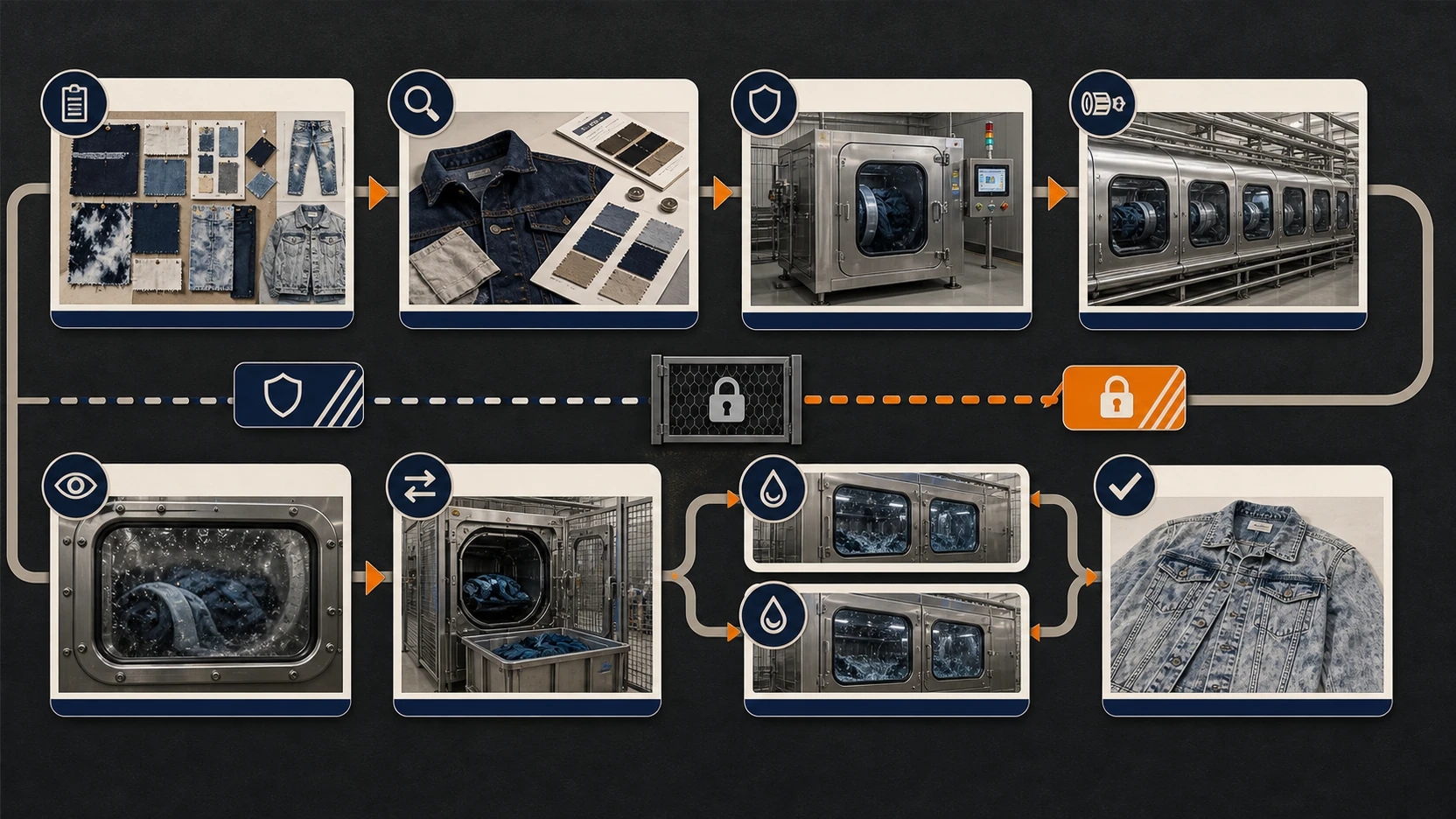
Translate the reference, identify the full garment, prepare only as required, apply the selected route, watch the endpoint and separate promptly.
Then neutralise, wash off, dry, condition, inspect and release. A wet appearance is not a final dry result.
Define and identify
Translate reference, identify fibre, dye, finish and complete BOM.
Develop and stop contact
Prepare, apply, watch endpoint, unload and separate promptly.
Release the product
Neutralise, wash off, dry, condition, inspect and release.
- Sizing can interfere with later chemical treatment, while controlled prior abrasion can create surface variation on denim.
- Garments in a carrier route must be removed promptly and separated from all carrier to reduce hot spots and complete local discharge.
- The selected chemistry requires its own neutralisation and wash-off route.
- Wet finishing and rinse streams remain part of facility chemical and wastewater management.
RELEASE THE CHEMISTRY
Reached the Look Is Not Ready to Ship
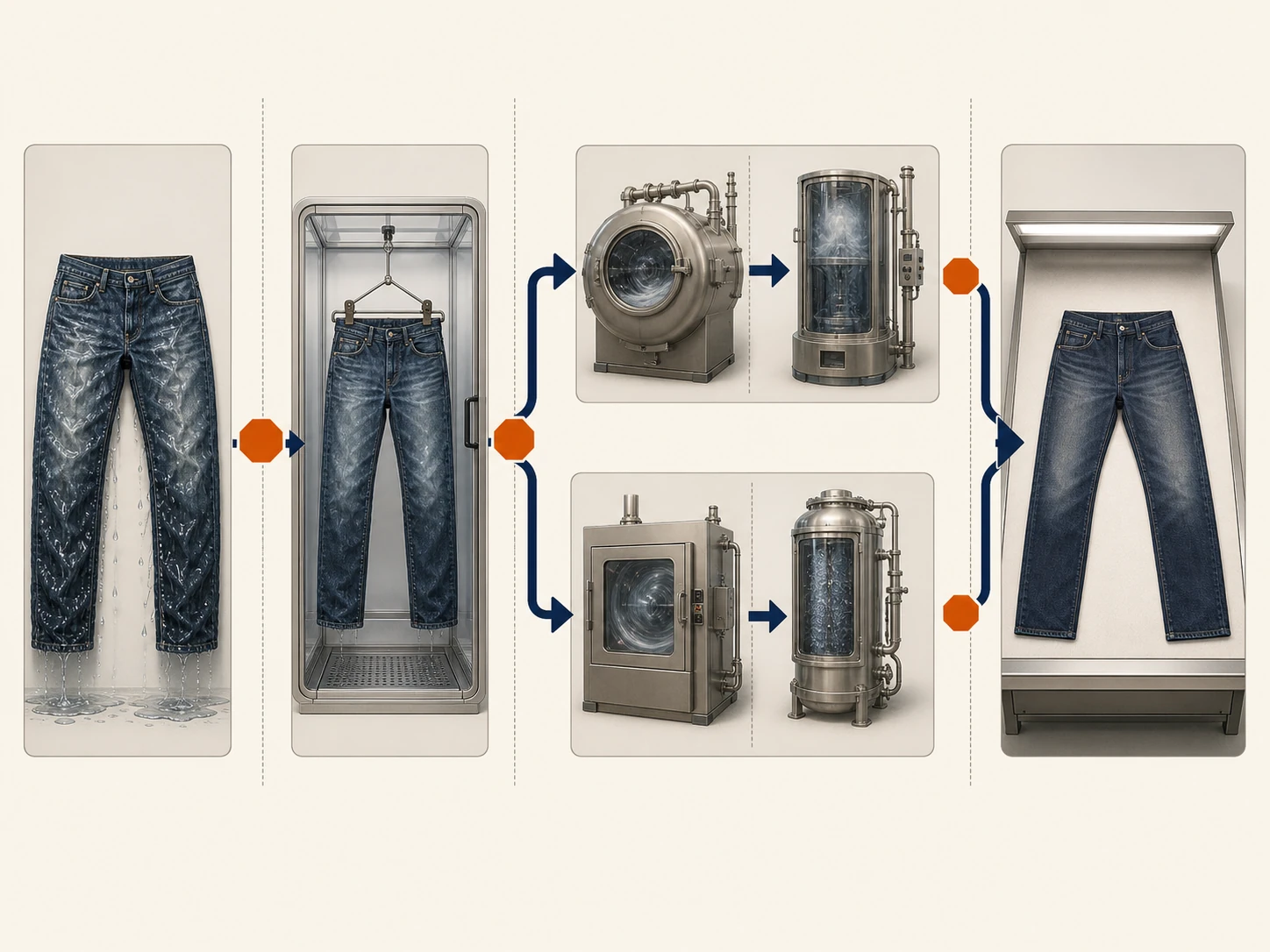
Visual target reached, contact stopped, route neutralised and washed-dry-inspected are four different states.
The word acid never authorises acid contact with hypochlorite, and neutralisation does not remove wastewater responsibility.
Visual target reached
The appearance has developed; chemistry may still be active.
Contact stopped
The garment is unloaded and the carrier is separated.
Route neutralised
Reduction or anti-chlor is completed to the validated route.
Product released
The garment is washed, dried, conditioned and passes agreed checks.
- Potassium-permanganate discharge routes require reduction or neutralisation followed by washing.
- Hypochlorite bleach routes require anti-chlor neutralisation and subsequent wash-off.
- Acid contact with hypochlorite can release toxic chlorine.
- Rinsing reduces pollutant loads in the studied denim facility but does not turn one study into universal plant performance or a discharge permit.
LOCK THE FINGERPRINT
A Sample Is a Result. A Fingerprint Makes It Repeatable.
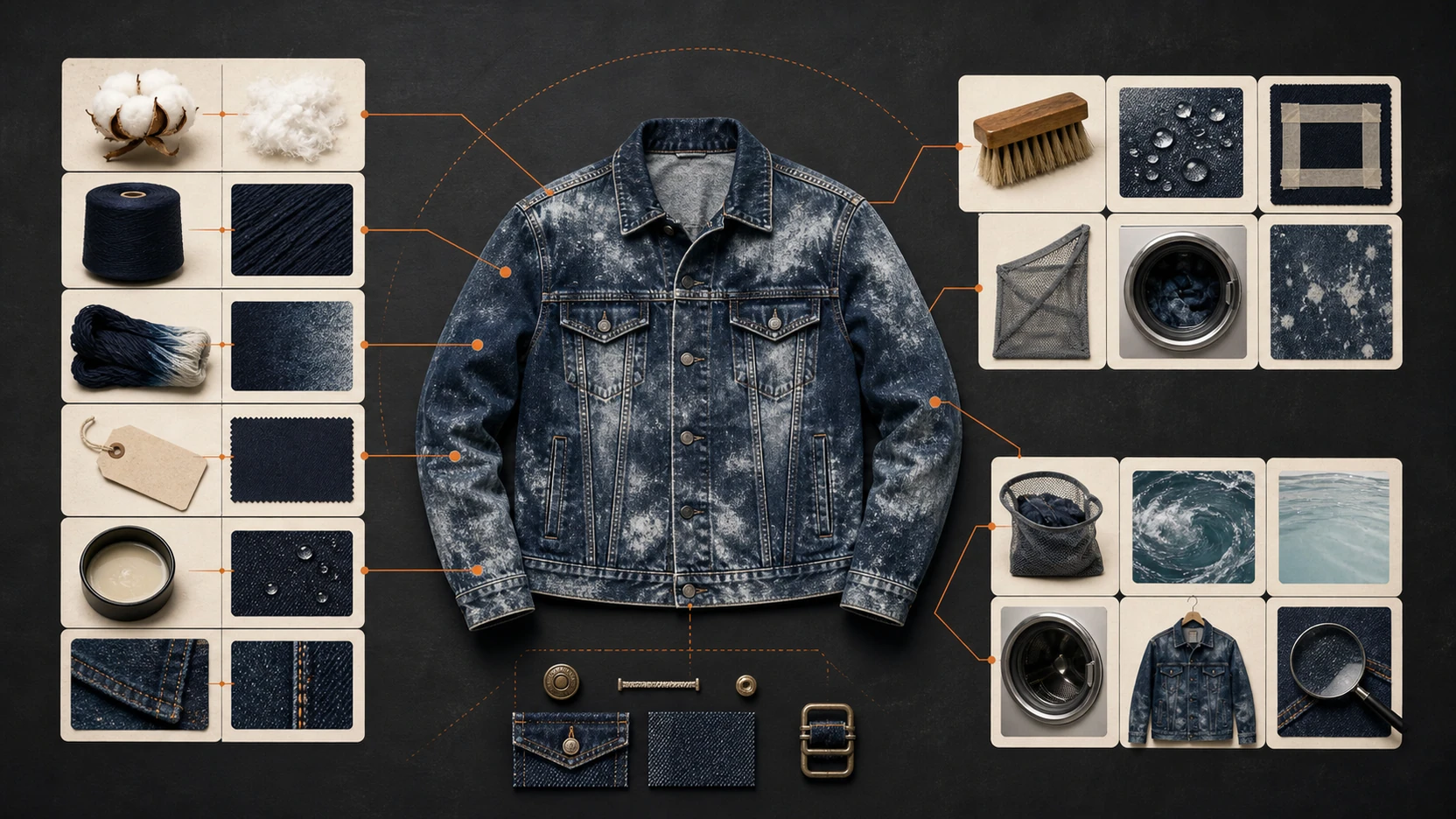
The approved dry garment sits at the centre of a material, application and release record.
The fingerprint is a production record, not a public universal recipe.
Material
Fibre, yarn, dye, depth, dyelot, finish, construction and complete BOM.
Application
Preparation, moisture, product, delivery, load, action and endpoint.
Release
Separation, neutralisation, wash-off, dry, condition, inspection and tests.
- Dye identity, shade depth, preparation, moisture, chemistry, application and endpoint can move the visual result.
- Defined bleaching studies show route, application, concentration and duration can change colour and physical properties.
- Separation, neutralisation, rinsing, drying and conditioning are part of the final result and release.
- A record cannot guarantee identical random marks, but it makes variation traceable against an approved range.
VALUE ↔ CONTROL
Every Stronger Effect Moves Another Boundary
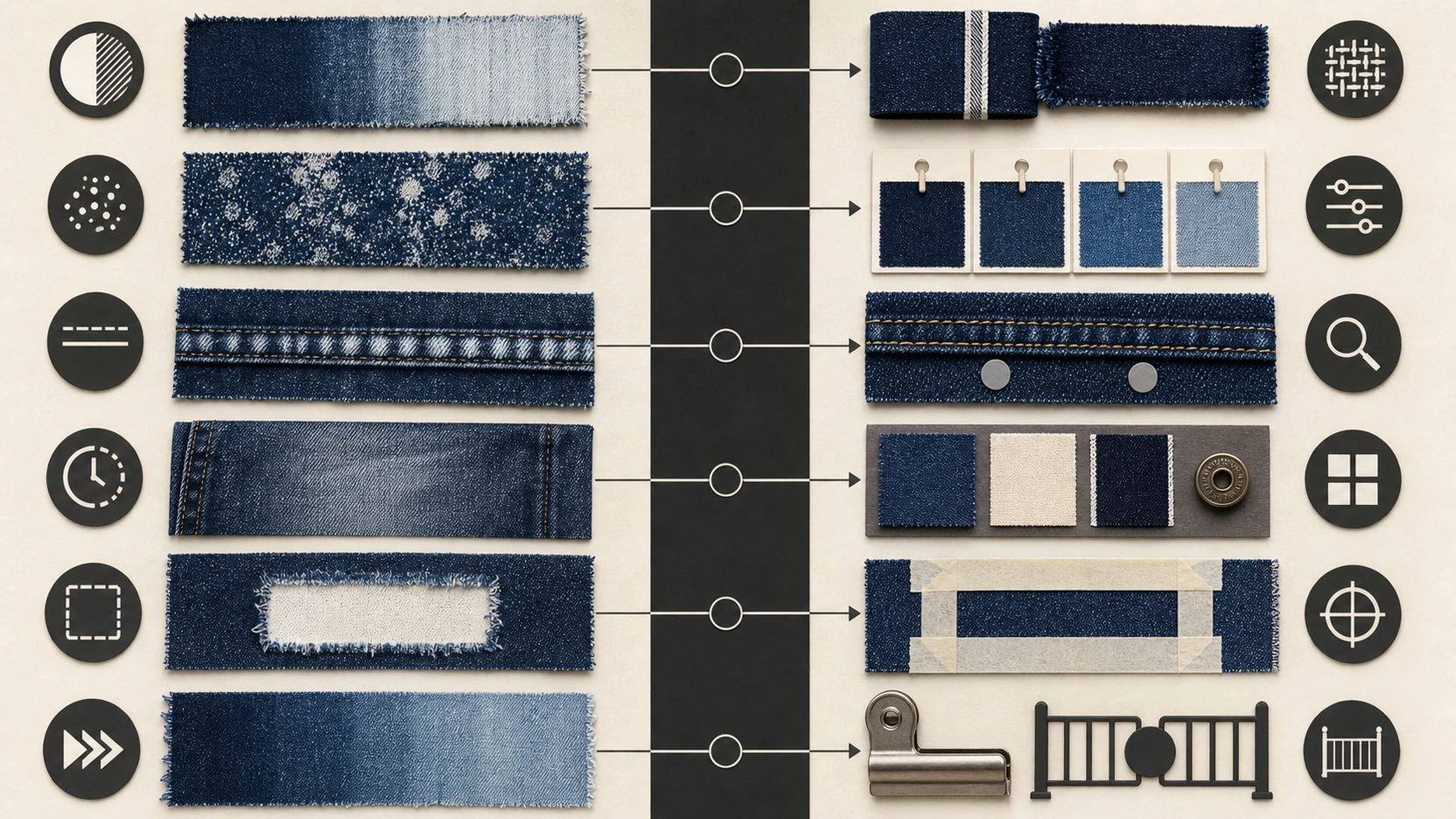
Choose the acceptable trade-off before the sample, not after the bulk lot.
A benefit is never shown without its coupled control.
Sharper contrast
Less strength and colour margin; tighter endpoint control.
Denser random field
More carrier contacts and a wider lot distribution.
Stronger seam highlights
Higher edge, seam and bartack damage risk.
Whole-garment ageing
Every thread, trim, zip, label and decoration enters the route.
Placed highlight
Tighter placement, masking and exposure controls.
Faster development
No assumption of safer chemistry or easier neutralisation.
- Stronger oxidative colour removal can reduce fabric strength or create corrosion and yellowing risk depending on the route.
- Random carrier contact and garment movement can widen effect variation and concentrate action at seams and edges.
- Complete-garment processing brings sewing thread, seams and zips into the risk boundary.
STYLE + STRESS MAP
A Good Fabric Can Still Fail as a Garment
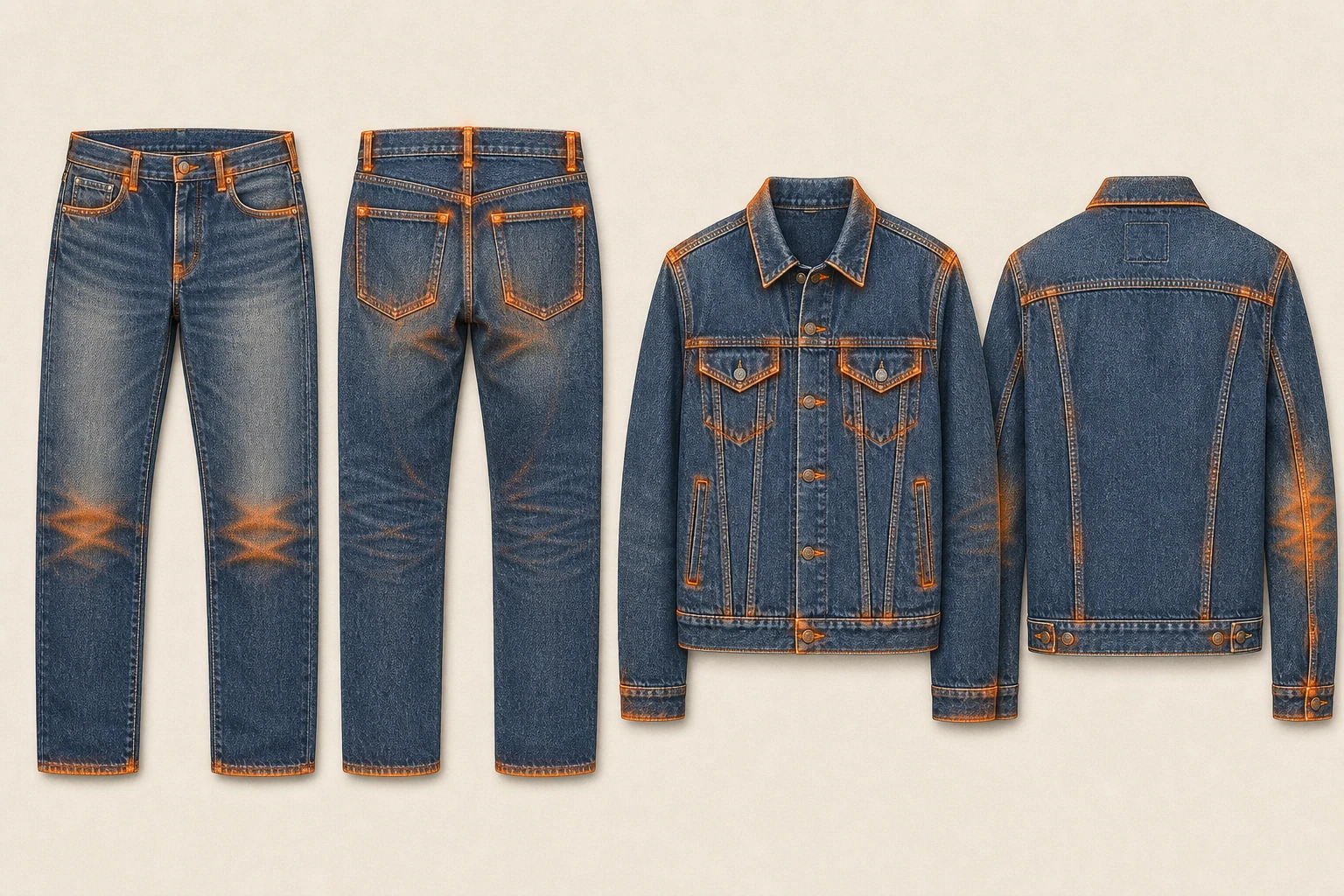
Denim pants, jackets and shorts are stronger starting candidates. Hoodies, joggers, T-shirts, stretch denim and lined or hardware-heavy styles remain conditional.
Inspect loops, pockets, fly, bartacks, cuffs, thick seams, rib, elastic, knees, seat, elbows, zips, labels and decorated zones.
Stronger starting candidates
Denim jeans, pants, jackets and shorts; heavy cotton twill after dye-route confirmation.
Conditional trials
Cotton hoodies, joggers, T-shirts, stretch denim and lined or hardware-heavy styles.
Stress zones
Loops, pocket edges, fly, bartacks, cuffs, seams, rib, elastic, hardware and decoration.
- Preparation and garment construction influence where abrasion or discharge concentrates.
- Thread, seam and zip behaviour can diverge from the shell under harsh denim washing.
- Product links remain conditional and require actual material, construction and sample confirmation.
DEFECT ≠ ONE CAUSE
Inspect the Variables Before You Name the Failure
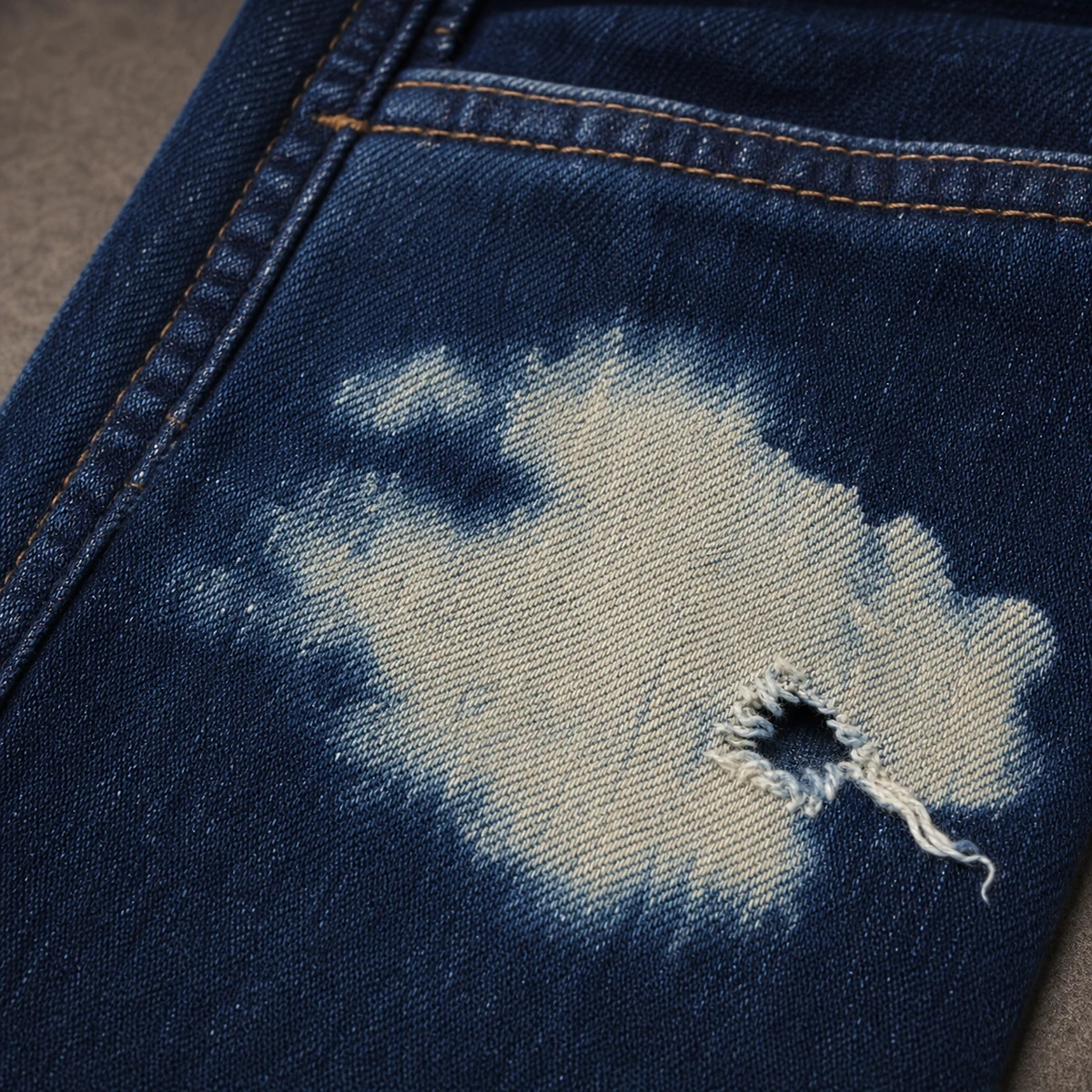
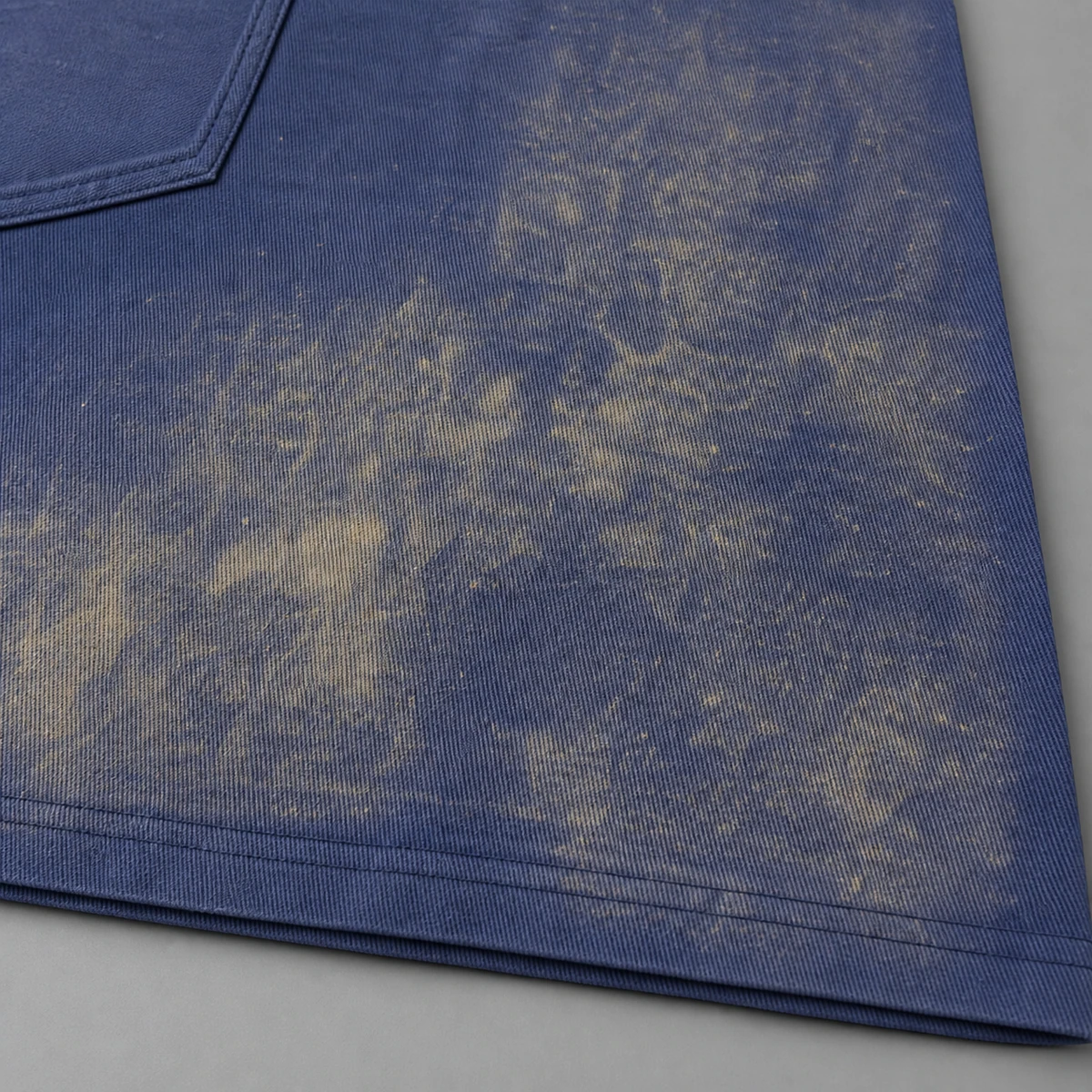
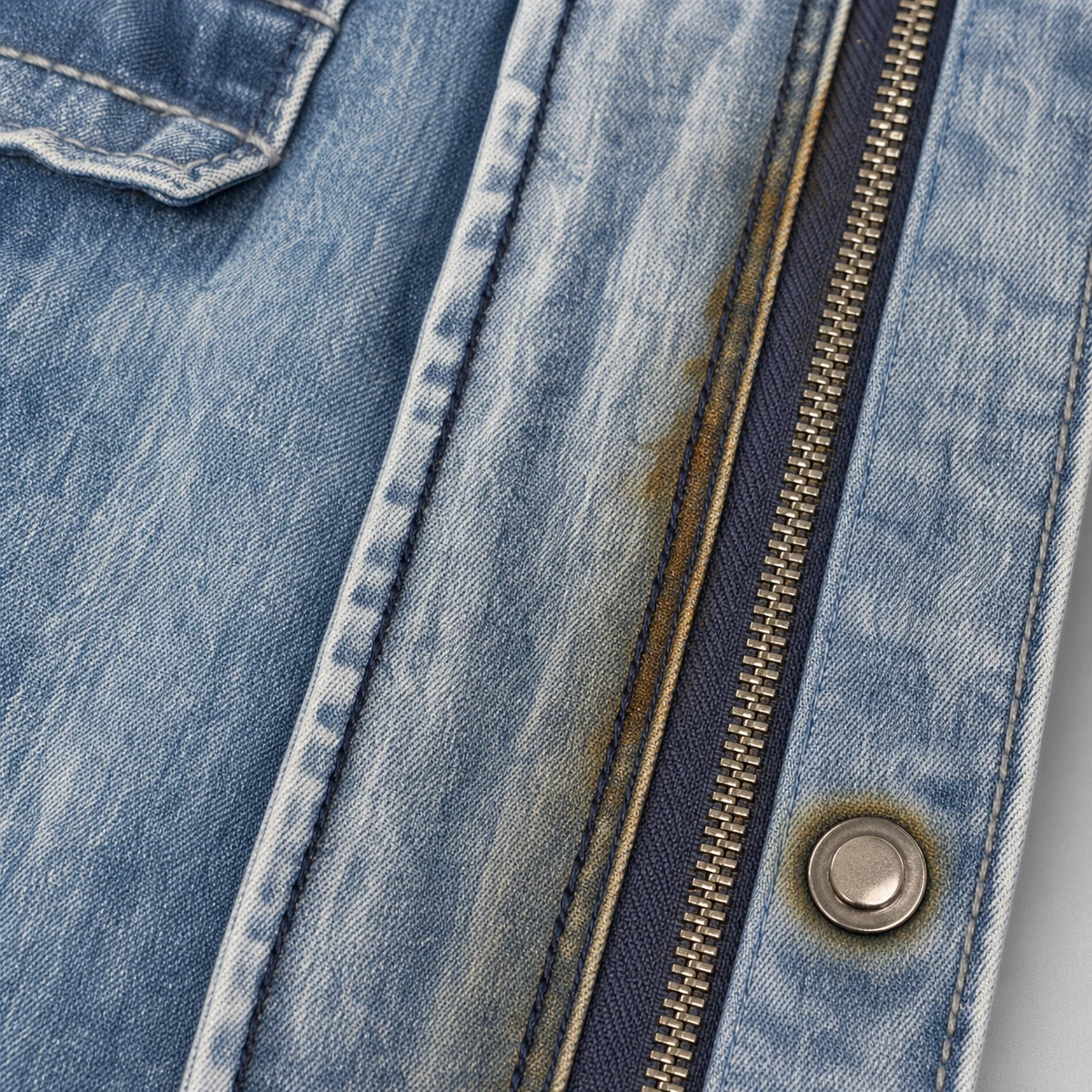
A visual symptom is a reason to check the route record, physical range and complete garment. It is not proof of one chemical cause.
Use separate defect references for over-discharge, residual appearance and component mismatch.
Over-discharge / weak zone
Inspect transfer, carrier, moisture, dwell, prior abrasion and seam concentration.
Residual / dirty appearance
Inspect reduction or anti-chlor, wash-off, metal interaction, redeposition and overprocessing.
Component mismatch
Inspect thread, pocketing, zip, hardware, trapped liquor and mechanical stress.
- Delayed separation or excessive local contact can create hot spots or complete colour discharge.
- Oxidative severity and process conditions can change strength, tear and rubbing results on defined denim samples.
- Residual appearance requires investigation of neutralisation, wash-off, redeposition and component interaction rather than diagnosis from colour alone.
- Thread, seams, zips and dimensions require their own complete-garment release checks.
APPROVE PHYSICAL RANGE
Seal the Minimum, Target, Maximum—and the Rejects
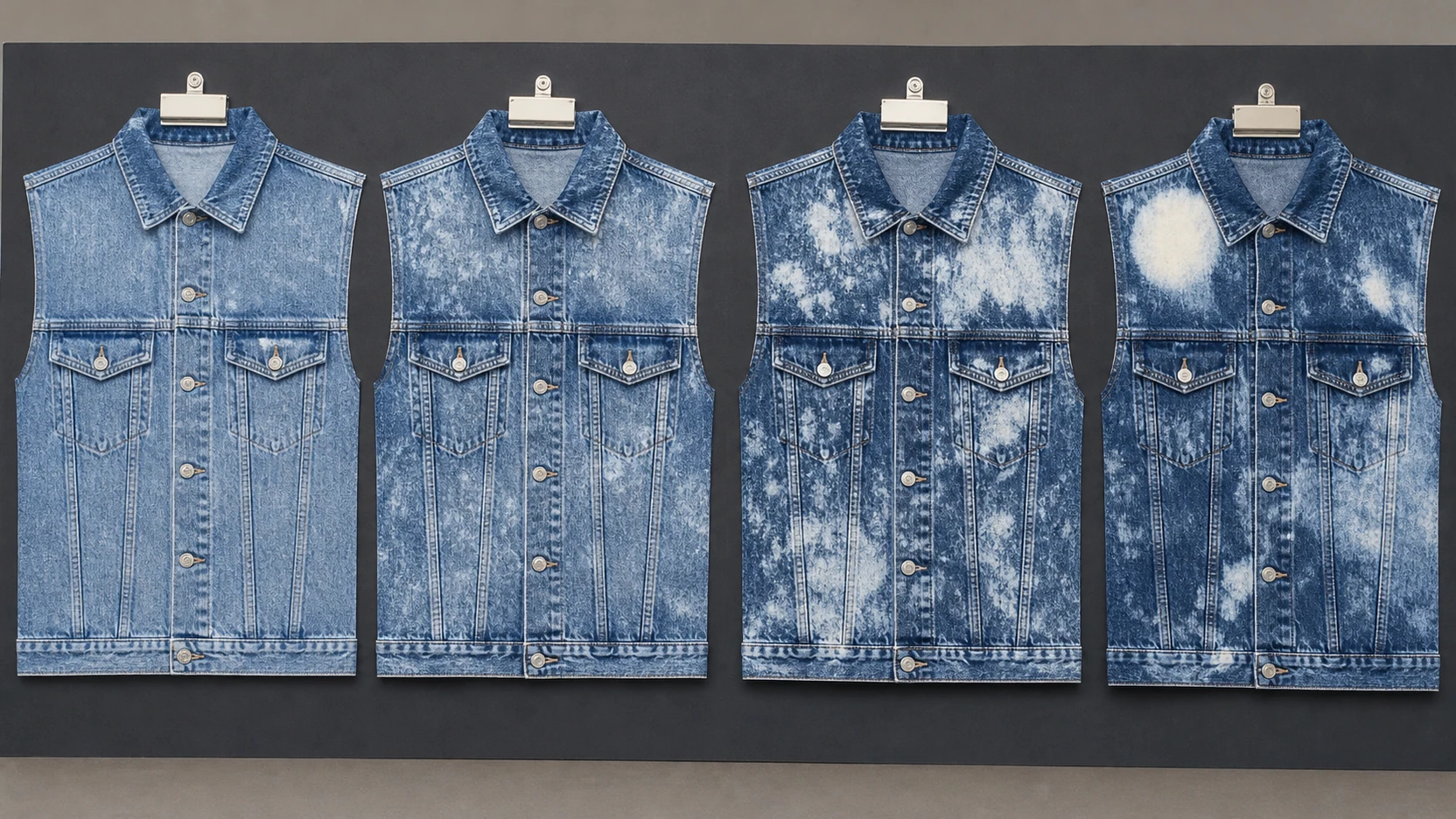
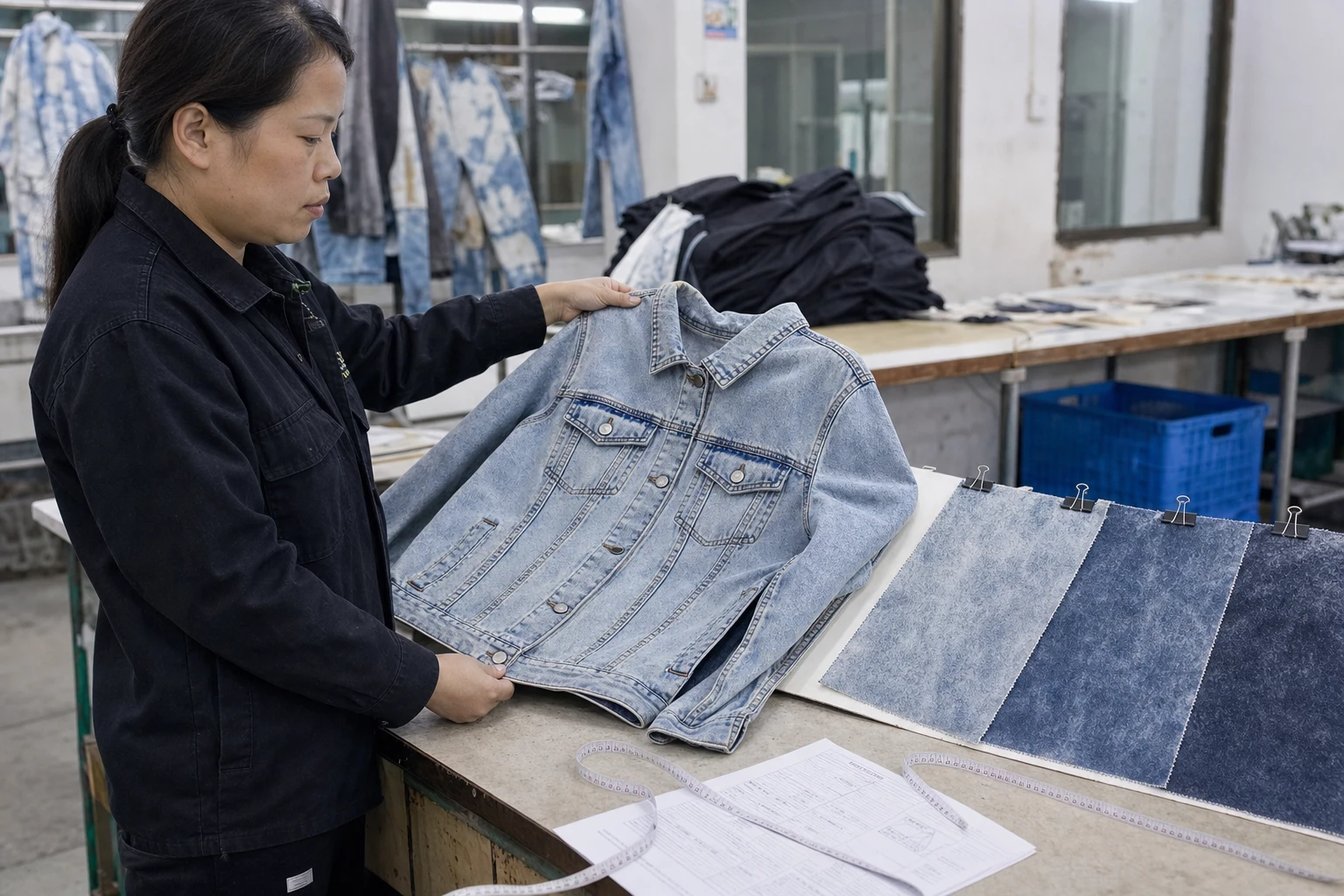
Approve physical minimum, target, maximum and reject garments after the full dry and conditioning route.
A named test method does not create one universal acceptance grade for every garment.
Minimum acceptable
The least contrast and mottle that still meets the brief.
Target
The intended commercial result on a dry complete garment.
Maximum acceptable
The highest contrast before visual or product boundaries are crossed.
Reject
Hot spots, complete discharge, dirty residual, holes, weak zones, trim stains, corrosion or off-placement.
- ISO 105-C06 provides laundering colourfastness methods; conditions and acceptance remain project-specific.
- ISO 105-X12 provides dry and wet rubbing colourfastness methods; acceptance remains project-specific.
- ISO 5077 provides dimensional-change determination after an agreed washing and drying procedure.
- Defined bleaching studies support route-specific colour and physical-property checks rather than a universal wash promise.
CHOOSE THE MECHANISM
Do You Need Discharge, Abrasion, Surface Change or New Colour?
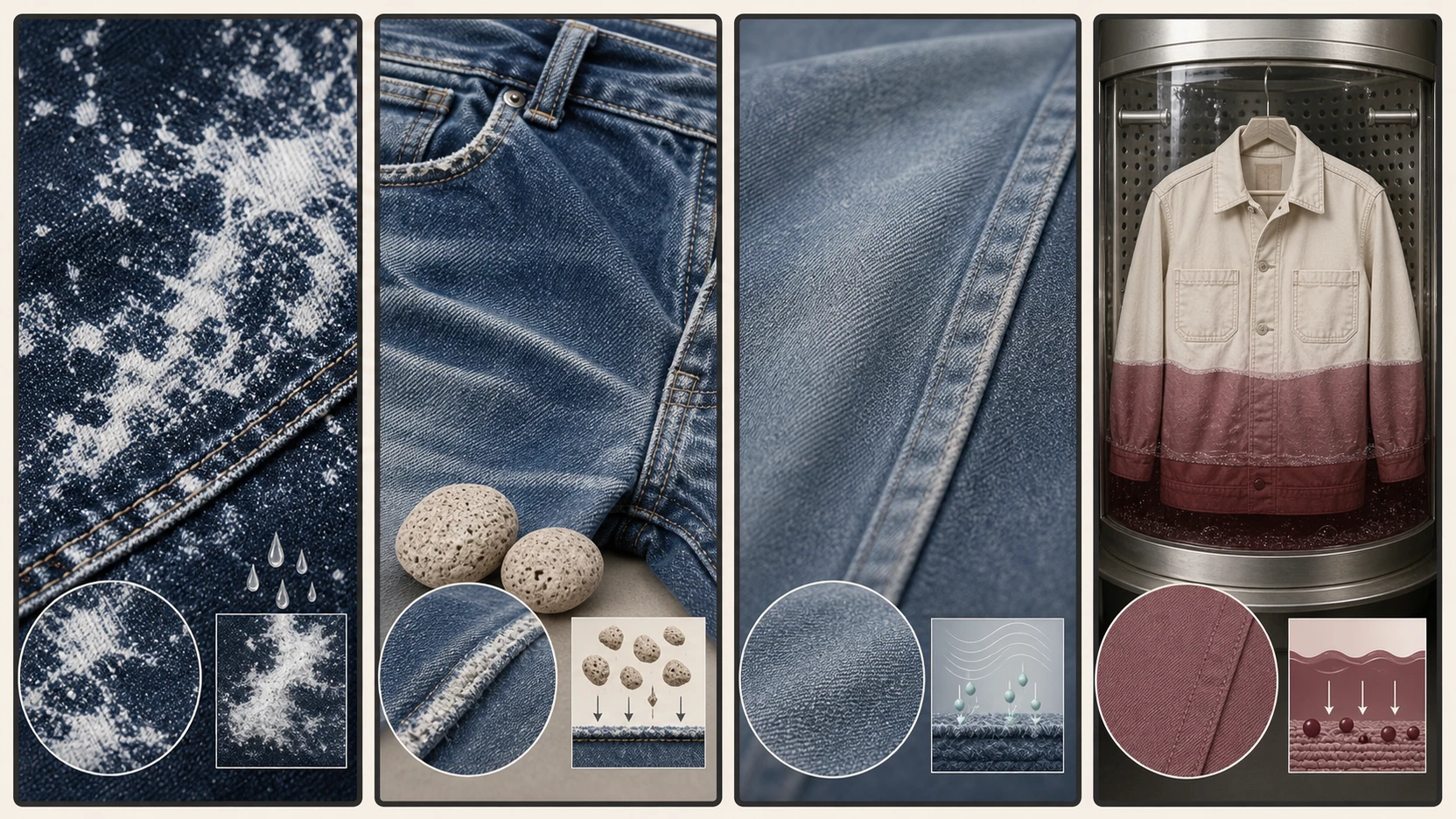
Choose Snow or Acid Wash for broken high-contrast colour removal, Stone Wash for pumice-led wear, Enzyme Wash for cellulosic surface change and Garment Dyeing for a new main colour.
Combined routes require a new complete process sample; they are not offered as unverified shortcuts.
Snow / Acid Wash
Broken high-contrast colour discharge.
Stone Wash
Pumice-led worn abrasion.
Enzyme Wash
Controlled cellulose-surface change.
Garment Dyeing
A new or tinted main colour after sewing.
- Snow and Acid Wash use controlled colour discharge followed by route-specific neutralisation and wash-off.
- Stone Wash is led by mechanical pumice abrasion, although other finish stages may be combined.
- Enzyme Wash uses cellulase to modify exposed cellulose and does not by default create the same sharp random discharge field.
- Garment Dyeing adds or tints colour after sewing and requires full-component compatibility.
BUILD A QUOTABLE BRIEF
Send the Effect, Material, Garment and Approval Conditions
Send what is known and label unknown dye or finish facts instead of guessing.
Our usual MOQ is 100 pieces per style per colour. Material or a specific style may require a different minimum.
Effect
References, base, contrast, mottle, coverage, placement, variation and rejects.
Material and dye
Fibre, construction, weight, stretch, finish, dye identity, shade and prior wash.
Complete garment
Tech pack, thread, pocketing, rib, elastic, hardware, labels and decoration.
Commercial and approval
Quantities, market, test protocol, sample calendar, approval owner and delivery target.
- Canton Fashion's approved public MOQ is normally 100 pieces per style per colour, with material or specific-style exceptions.
- Technique fit must be confirmed from the actual material, colour, stretch, structure, design, quantity, process tolerance and sample.
BUYER FAQ
Questions to Settle Before Sampling
The visible FAQ must be identical to any FAQ structured data.
Answers remain conditional on the actual garment and qualified processor route.
Are snow wash and acid wash the same?01
They can overlap as trade names, but neither name proves one route. Confirm the target effect, material, dye, chemistry and delivery.
Does acid wash use acid?02
Not in the familiar denim route documented by CottonWorks. Acid wash is a misnomer; never mix acid with bleach.
What is a PP wash?03
PP usually means potassium permanganate. Record both its controlled delivery method and the required neutralisation.
What does chlorine wash mean here?04
A professionally controlled hypochlorite-based discharge route, not chlorine gas. Confirm the exact product, SDS, anti-chlor and wash-off.
Which fabric gives the clearest classic effect?05
Indigo ring-dyed cotton denim is the strongest documented starting point. Other materials need dye-specific trials.
Can it be used on hoodies or T-shirts?06
Potentially, but only after checking the exact fibre, dye, weight, rib, thread, decoration and complete-garment wet route.
Can every piece look identical?07
No exact-copy promise is appropriate for a random contact effect. Approve a physical minimum, target and maximum range.
Can we match a Pantone?08
Pantone may describe the starting colour, but discharge exposes a material-dependent residual tone. Approve dry physical garments.
Will the wash weaken the garment?09
It can change strength depending on fabric, prior abrasion, route and severity. Select relevant complete-garment tests.
Why must trims be sampled?10
Thread, pocketing, elastic, zips, hardware, labels and decoration can react differently from the shell.
Is neutralisation just a final rinse?11
No. The route needs its own reduction or anti-chlor step followed by wash-off, drying and product inspection.
Is the process eco-friendly?12
The name proves nothing about water, chemistry, exposure or wastewater. Claims require verified facility and process data.
How is this different from Stone Wash?13
Stone Wash is led by pumice abrasion. Snow or Acid Wash is led by controlled colour discharge.
How is this different from Enzyme Wash?14
Enzyme Wash modifies exposed cellulose for surface change; it does not by default create a sharp random discharge field.
How is this different from Garment Dyeing?15
Garment Dyeing adds or tints colour after sewing. Snow or Acid Wash removes part of an existing colour.
What must I send for a quote?16
Send references, tech pack, material and dye facts, full BOM, effect range, quantities, tests and approval schedule.
What is the MOQ?17
Our usual MOQ is 100 pieces per style per colour. Material or a specific style may require a different minimum.
- Snow and acid names do not identify one universal route, and acid wash is not an instruction to use acid.
- Indigo ring-dyed cotton denim is the clearest documented starting point; other materials need their own trial.
- Thread, seams, zips, hardware and dimensions require complete-garment checks.
- The approved MOQ answer is normally 100 pieces per style per colour, with material or specific-style exceptions.
PROJECT INPUT
Start With a Route-Ready Brief
A reference name does not confirm the route. Material, dye, full garment construction, quantity and sample requirements are reviewed before feasibility is confirmed.
The form uses the existing site contract. It must not claim upload, delivery, CRM storage or successful submission until the real backend is verified.
Contact
Name, company, work email and country or market.
Product and quantity
Product type, quantity by style and colour, and target date.
Material and effect
Fibre, fabric, weight, dye, stretch, finish, contrast, mottle, coverage and placement.
Whole garment and approval
BOM notes, test requirements, reference upload and project message.
- The usual MOQ is 100 pieces per style per colour, subject to material or specific-style exceptions.
- Technique feasibility remains conditional on the actual project inputs and sample testing.