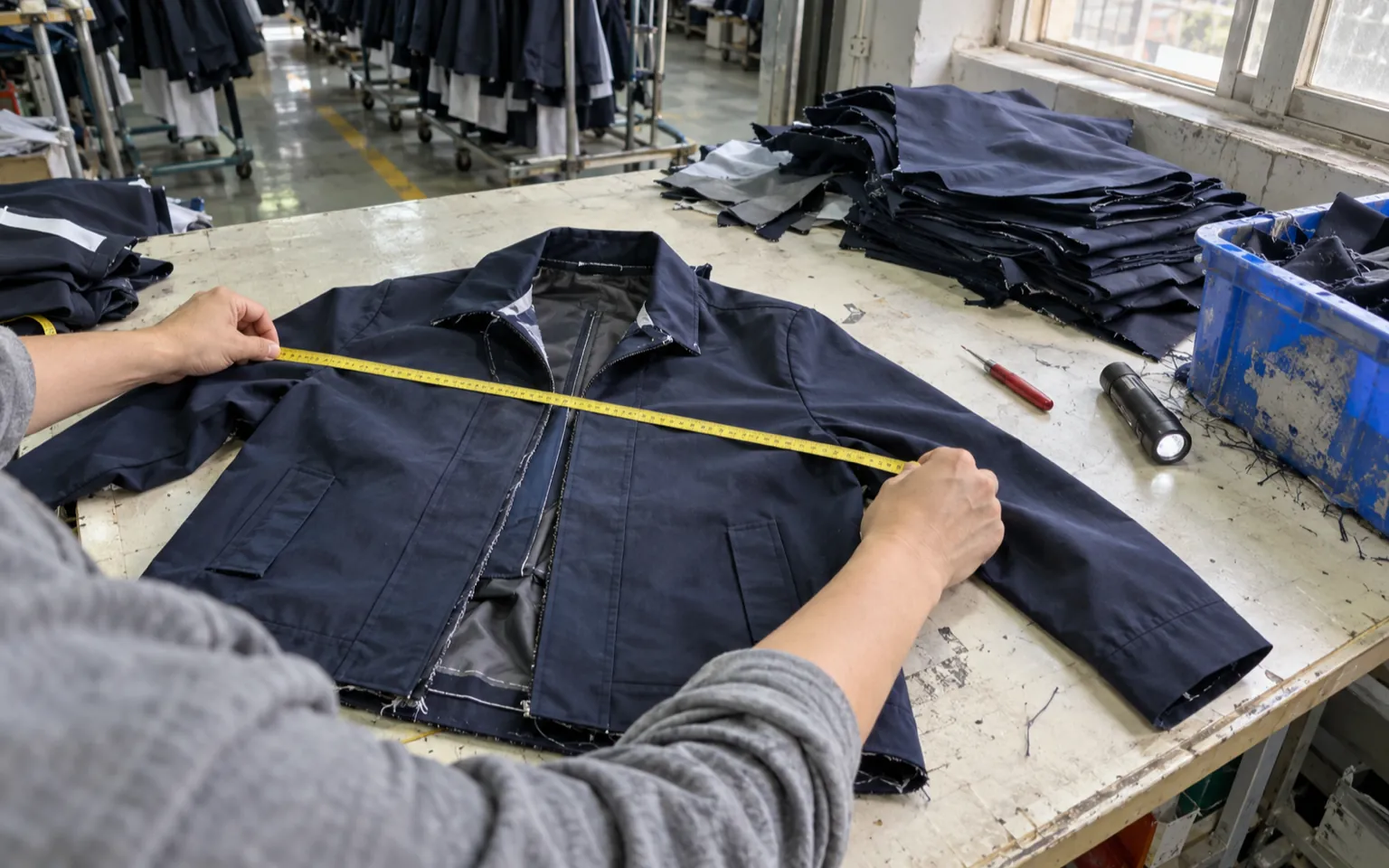
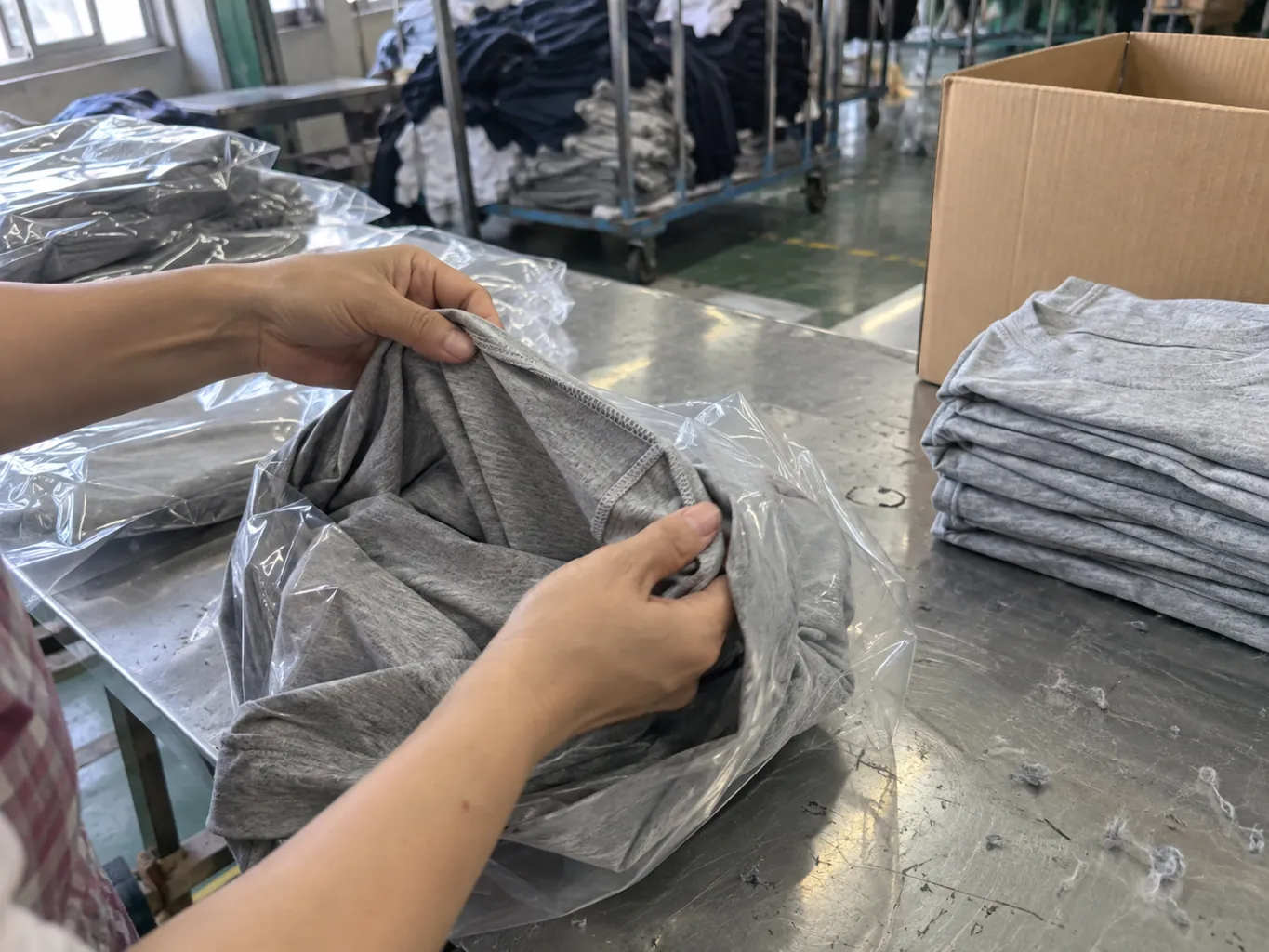
Canton Fashion has been making OEM and ODM apparel out of Guangzhou since 2015, working with a network of partner factories. In that time, the orders we have watched fail did not fail because the unit price was high or the sewing was poor. They failed because nobody locked down one piece of information — a logo version, an inspection standard, a packaging artwork file — the moment they confirmed the order. Three of those cases are at the end of this page, and they are the reason this page is organized the way it is.
Use this page rather than read it once: nine questions you can copy into an email to any custom apparel manufacturer on your shortlist, plus the answers that should satisfy you and the answers that should not.
How Do You Tell Whether a Custom Apparel Manufacturer's Quality Control and Compliance Can Be Trusted?
Check three things: certificate ownership, in-house QC records, and your inspection right.
You can check each of those three with a document or a scheduled action — from another continent, before money moves. Everything else a factory says about quality is a claim: it costs nothing to make, and you cannot check it from a distance.
Split what you hear into two buckets.
Verifiable signals:
- The audited entity name and address on an audit report, matched against the entity that will actually produce your order
- Test reports whose product name, material, and style match the goods you are buying
- QC records from previous shipments, even with client details redacted
- An inspection clause in the order confirmation, with the judgment standard attached
- A named person who can walk you through the line on a live video call
Unverifiable claims:
- "We have strict quality control"
- "We have passed many audits" — which factory, which year, which entity?
- "We have never had a quality problem"
- "You do not need to inspect; we check everything ourselves"
None of the second list is necessarily false. It is simply not evidence, and a first order is a bad place to test a claim.
This page sticks to quality control and compliance. Product development and price negotiation are separate conversations. Treat each heading below as a question to send to every factory on your shortlist, using the same wording. The answers are more useful side by side than on their own, because the weakest candidate usually disqualifies itself in writing.
The Factory Says It Has BSCI — How Do I Verify That?
Ask for the report number, check who was audited, and confirm the date is current.
BSCI, run by amfori, is a social compliance audit rather than a product certification. It records that a named production entity was audited against social and labour criteria on a certain date. It does not certify that your fiber content label is correct for the US market, and it says nothing about whether a child's jacket passes the small-parts test.
Our own situation, stated plainly: Canton Fashion was founded in Guangzhou in 2015 and coordinates a network of partner factories. The BSCI report we can show you sits under the name of the partner factory that will run your order — it is not a certificate held by Canton Fashion itself. That arrangement is common in this industry and is not automatically a problem. What matters is whether the entity named on the report is the entity making your goods, at the address where they are made.
Three checks turn "we have BSCI" into a fact:
- The audited entity — compare the company name and address on the report with the name on your production order and the address of the site. A report covering a different legal entity, or a sales office rather than a production site, does not cover your order.
- The date and the conclusion — both are printed on the report itself and visible in the scheme's database once you have the report number, so read them there rather than accepting the factory's summary
- The follow-up — industry-wide, under amfori's rules a full BSCI audit is valid for two years, and a grade below B obliges the supplier to complete a follow-up audit between two and twelve months after the full audit An audit is a snapshot of one period, not a permanent status. If the follow-up was never completed, treat the report as history.
For the partner factories we work with: the BSCI report is issued in the partner factory's name, not in Canton Fashion's own name, and this must be stated openly to buyers — ask us for the exact company name and address on the report and check them against the production order and the site before committing anything
Do not accept a screenshot, and do not accept a PDF as the final word. Ask for the report number and look it up yourself in the audit scheme's public database. Screenshots travel between factories and get reused; a database entry tied to a report number is much harder to fake.
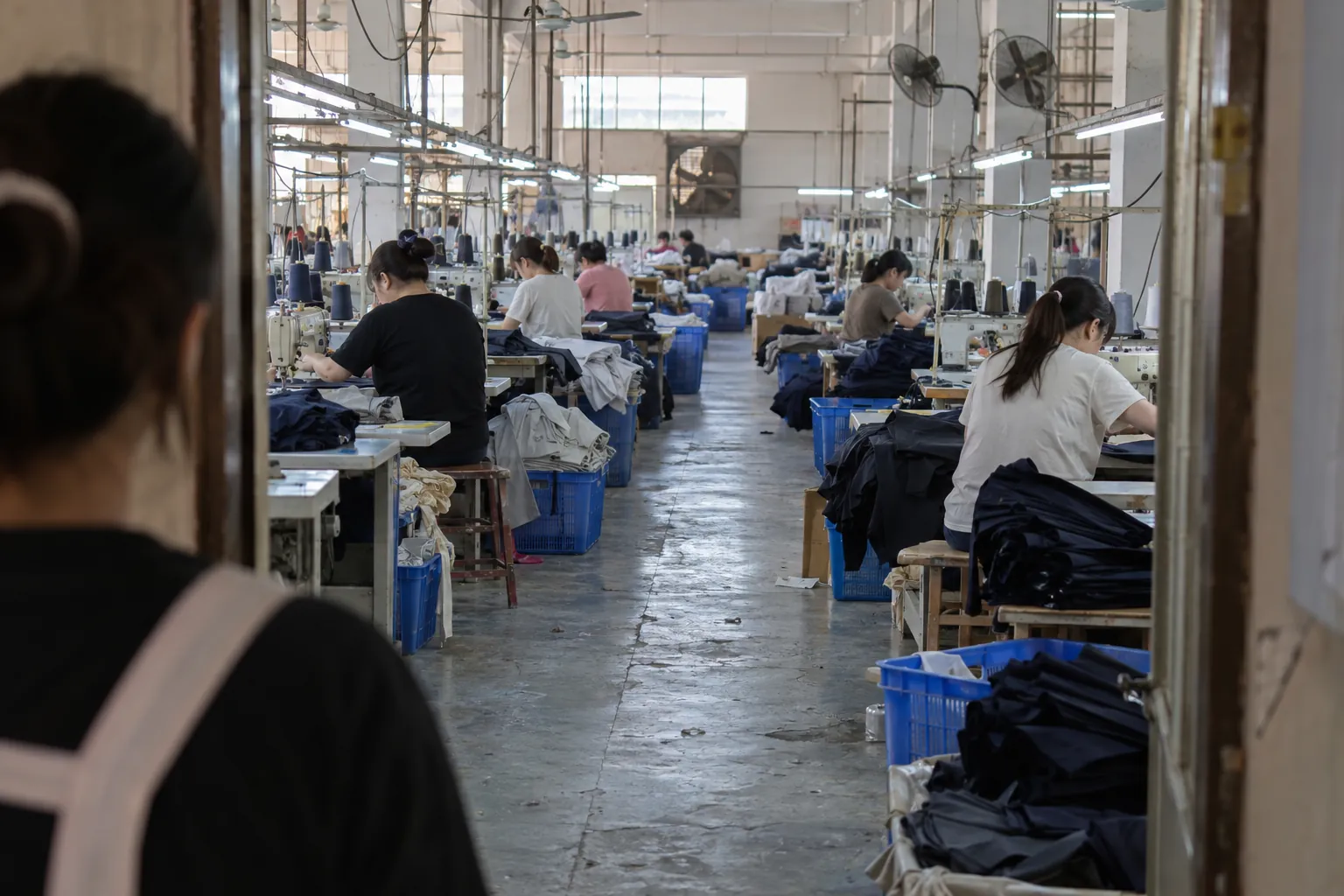
Beyond the Factory Audit: What Compliance Rules Does Your Product Have to Pass?
A social audit is not a product test, and the legal duty for product compliance is yours.
Three separate layers decide whether your goods can be sold: the social audit that covers the factory, the test reports that cover the product, and the labeling and chemical rules of the market you are selling into. Suppliers blur these together because one document is easier to talk about than three.
The legal responsibility for product compliance sits with the importer or the brand — you — not with the factory. A Chinese factory cannot be the importer of record for your US or EU sales, and it cannot carry your liability. What a factory can do is supply accurate material information, arrange testing with a lab you nominate, keep reports on file, and produce to the specification you approve. Treat compliance as your checklist that the factory executes, not as a service the factory owns.
For the US market, four questions belong in the order document: how fiber content and country of origin must be shown on the label; what care labeling is required; what additional testing applies to children's items; and which state-level chemical rules touch your materials. These are industry-wide rules, not factory policies: US federal law requires most textile products to carry a label listing the fiber content, the country of origin, and the identity of the manufacturer or dealer, with care labeling governed by the FTC's care-label rule; children's products carry additional third-party testing and certificate duties; and states pile on their own layer — California and New York are among the most heavily regulated, and California's Prop 65 requires a warning whenever a listed chemical exceeds its safe-harbor level
Europe runs the same exercise with different rules, led by textile labeling and chemical restrictions. Again these are industry-wide obligations: every EU and non-EU brand selling textile products in the EU must comply with the EU Textile Labeling Regulation, and REACH restricts the chemicals in the goods — any substance of very high concern present above 0.1% of the product's total weight triggers disclosure and notification duties
Children's and infant items are a separate, stricter category. Do not let anyone reuse an adult style's test report for a kids' version; the test items are not the same, and the material composition may not be either. In the US the extra layer is formal and industry-wide: children's products must be tested by a CPSC-accepted third-party lab and must ship with a written Children's Product Certificate (CPC) demonstrating compliance with the applicable rules — lead and phthalates among them, and ASTM F963 where the item is also a toy
Three things the factory should hand over before you commit: a list of the test reports it already holds for the materials and styles involved; a clear statement of who pays for testing and how many days it takes; and confirmation that the product name, material composition, and style on each report match what you are buying. A report written for an 80/20 poly-cotton fleece hoodie does not cover a 100% cotton tee, so when no matching report exists, agree before the deposit who commissions a new test, with which lab, and who pays — and get the cost and the turnaround time in writing
Without Sitting in the Factory, How Do You Confirm the QC Process Is Actually Running?
Ask for records, not promises: material checks, in-line checks, and a pre-shipment report.
You cannot verify quality control that exists only in conversation when you are on another continent. What you can verify is a chain of three checkpoints, each of which leaves a document behind.
- Incoming material inspection — fabric and trims are checked against the approved swatch and specification when they arrive. Ask who does it, what they compare against, and what happens to a roll that fails.
- In-line inspection during cutting and sewing — ask how often QC staff walk the line, what they write down, and how a defect found mid-batch is corrected before it repeats.
- Pre-shipment final inspection — finished, packed goods are sampled and checked before they leave the factory.
Then ask the factory for three things. A sample inspection report (one page shows whether they record measurements, defects per hundred units, and photos); QC records from the last three shipments, with client names redacted; and a written description of what happens to a defective unit — rework, replacement, or discount — and who signs off on it.
AQL is what turns "we check the goods" into something a third party can judge. AQL is a sampling standard: it defines how many units are pulled from a batch and how many defects are allowed before the batch fails. For ordinary consumer apparel, buyers commonly write AQL 2.5 for major defects and 4.0 for minor ones into the order. The mistake to avoid is judging ordinary consumer goods by a luxury standard; that mistake has cost buyers entire shipments, and one of the cases below shows how.
Two things you can do this week without a plane ticket. Ask for a live video walk of the line and the QC station during working hours — a factory that sends a staged clip instead of walking you through the floor in real time is telling you something. Then pick one past order at random and ask for its final inspection report and its QC records together; the two should describe the same batch. Where the in-house records and the third-party conclusions disagree, that is exactly where you book a visit.
In-House QC, Third-Party Inspection, or a Formal Audit — Where Should a First Order's Budget Go?
On a small first order, spend it on the pre-shipment inspection: $100–200 USD per person-day.
These are three different services, and buyers mix them up constantly.
| What you buy | What it actually looks at | Typical cost | When it pays off |
|---|---|---|---|
| A simple factory visit | The site, the lines, the equipment, the people who will run your order | $100–200 USD per person per day | You are choosing between two factories and want to see both |
| A formal audit | Management systems, documentation, and social compliance, over a full day or more | $3,000–5,000 USD | You are placing a large or long-term program, or a retail customer demands one |
| A pre-shipment inspection | The actual batch you are about to pay for, sampled against your standard | $100–200 USD per person per day | Every first order, and any order where the goods matter |
They are not substitutes. A factory visit tells you whether the place is real. A formal audit produces a system conclusion, which is why it costs what it costs. A pre-shipment inspection is the only one of the three that looks at your goods.
For small orders, our own advice is to skip the pre-production inspection and put the budget into the final inspection instead. A 100–500 unit run does not have enough production days to justify two inspection visits, and the final check is the one that catches what would actually ship.
Timing is where first-time buyers lose the most. Book the inspection before the goods are packed and before you book the vessel. Treat the three dates as one calendar: goods finished and packed, inspection done, balance paid, container loaded. The booking trigger is industry-standard: a pre-shipment inspection is performed once production is complete and roughly 80% of the order is packed — book earlier and there is nothing final to sample; book later and a failed batch has already missed the vessel And the paperwork is quick by industry norm: inspection firms typically deliver the written report within about 24 hours of the on-site visit, so a passed inspection should not hold the vessel date. If the inspection date slips, the vessel booking slips with it, and the delay lands on your launch date rather than on the factory's.
One last point: the inspector judges your goods against the standard you give them. If the order says nothing about defects and tolerances, you get a report you cannot argue with in either direction. Write the standard into the order before production starts, not into the email that follows the inspection.
First Order of 100–500 Pieces: What's the Minimum Set of Checks?
Six steps: certificate owner, AQL in writing, locked sample and artwork, inspection, payment.
In order, with who does what and what comes out of it:
| # | Step | Who | When | Output |
|---|---|---|---|---|
| 1 | Confirm the producing entity and whose name is on the audit report | You and the factory | Before the deposit | Report number and entity name written into the order |
| 2 | Agree the inspection standard in writing (AQL 2.5 / 4.0 for consumer apparel) | You | Before the deposit | An inspection clause in the order |
| 3 | Approve the sample and freeze the design version | You | Before bulk starts | Approved sample plus a version number in the order |
| 4 | Confirm packaging, hang tags, and label artwork | You | At order confirmation | Artwork files signed off |
| 5 | Pre-shipment inspection on packed goods | A third-party inspector or your own QC | Before the balance is paid | Inspection report |
| 6 | Pay the balance and ship | You | After a passed inspection | Balance receipt and shipping documents |
On quantity: our minimum order is 100 units, and most first orders we see run 100–500 units. At that scale the final inspection is enough cover — you do not need to buy a formal audit for a 300-unit run. E-commerce clients who reorder successfully can reach several thousand units, sometimes tens of thousands. At that volume, a fuller inspection schedule starts to pay for itself.
On money: new clients pay a 30% deposit, the finished goods can be inspected before shipment, and the balance clears before the goods leave. The order of those three steps is the protection — not the percentage on its own.
And the judgment call this whole page comes down to: if a factory resists an inspection clause, or tells you inspection is unnecessary because they check everything themselves, you have your answer. An inspection costs far less than a container of goods you cannot sell.
How Do You Ask About Capacity and Lead Time So You Know Your Order Fits?
Sampling 7–14 days, bulk 30–45 days after sample approval — ask for both numbers, not one.
A single lead-time number is the easiest thing in this business to promise and the hardest to hold. Split it into two: sampling runs 7–14 days, and bulk production runs 30–45 days counted from sample approval — not from the deposit, and not from the order date. Ask which event starts the bulk clock, and write that event into the order.
Capacity only means something per category, and honest capacity numbers are soft, because the answer changes with the style. Do not ask how many units a factory can make a month in general; ask for your product type. As a reference from our own production, T-shirt and hoodie orders run 30,000–50,000 units a month, while dresses, suits, and more complex styles run 10,000–20,000 units a month. If a supplier quotes a large number for a category they do not normally run, the number is decoration.
Then ask the scheduling questions, in writing: where does my order sit in your line right now; how far does the peak season push that out; what happens if a fabric shipment arrives late; and how do you handle a rush order that jumps the queue. On peak season, treat the US holiday window as an industry-wide constraint: peak-season ecommerce runs from Q4 into early Q1, preparation starts well before the first holiday shopping event of the season, factory lines fill in that same window, and retail planners now push holiday planning earlier each year — so ask a factory directly how far ahead a peak-season slot needs to be locked Finally, get the schedule onto a formal document, not into chat: a purchase order or order confirmation that records the agreed delivery date, quantity, price, and terms — with any change to the schedule re-confirmed in writing by both sides
This is where the price-only decision fails. A factory that is slightly cheaper per unit but cannot ship inside your selling window costs you the season, not the small saving. Ask for the shipping window first, then negotiate price inside it.
Count your own lead time too. Custom zipper bags, printed hang tags, and woven labels have their own production time — a printed zipper bag alone can take three to four weeks — and those weeks sit on your side of the calendar. They only start once you approve the artwork, which is exactly the step one client skipped. Her case is below.
How Do You Negotiate Payment Terms and Inspection Rights to Protect Both Goods and Money?
30% deposit, inspection before shipment, balance cleared before the goods leave — in that order.
For a new client, those are our terms: a 30% deposit to start production, the right to inspect the finished goods before shipment, and the balance paid before the goods leave. Read the order of those three again, because that is where the protection sits on both sides. You never pay in full before seeing the actual batch, and the factory is not financing your production either. That balance is why the arrangement holds together without a long relationship behind it.
For clients we have shipped for a while, the balance can carry 30–60 days of credit, based on a Sinosure check of the buyer. That is a condition you earn with a shipping history, not a first-order bargaining chip — and a new supplier who offers it immediately is either not planning to check or not planning to be around. Do not build your first-order budget on it.
On payment methods: we use a regular PayPal account, not a PayPal Business account. The more useful fact is our own record rather than a policy number: in more than ten years of business, no buyer has ever filed a complaint against us, and we have never had a PayPal chargeback.
Whatever you agree, move it out of the chat window and into the order confirmation or the contract. Write down the inspection right, the inspection standard, the payment schedule, and the point at which title and risk pass to you. Chat messages are weak evidence for both sides. A signed order confirmation with an inspection clause is what you point at when a batch is disputed.
Payment terms discussed before the deposit are terms. The same conversation after production starts is a request. Have it early.
Ten Years of OEM Work: Which Mistakes Actually Cost Brand Owners Their Orders?
Three: bulk before sample approval, inspection standards set too late, packaging confirmed too late.
All three came out of our own order history, and in each one the loss landed on the buyer's side of the table.
Bulk released before the sample was approved.
The buyer did not wait for sample approval and pushed the factory to start bulk. The logo that came out did not match the final design file — the version was wrong. That is not a workmanship defect, but it is a difference from the logo on the brand's own website, and that difference is what shoppers see. The fix costs nothing: confirm the sample and the design version in writing before bulk starts, and put the version number in the order. A file called "logo final v3" in a chat thread is not version control.
No inspection standard agreed before production.
This buyer never set an inspection standard. At inspection, the check went far finer than the product warranted — points that most people would not treat as defects were written up, and the batch could not ship. Judged against civilian inspection standards such as AQL 2.5 and AQL 4.0, the same batch would have passed. These were ordinary consumer goods, not luxury pieces, and the standard has to match the price point and the market. Agree the standard and the judgment criteria in writing before the order starts, including what counts as a major defect and what counts as a minor one.
Packaging confirmed after the order.
A client, Ann Lin, confirmed her order without confirming the packaging. Only when the goods were ready to ship did she ask for a custom zipper bag. A printed zipper bag takes three to four weeks to produce, and there was not enough time left, so the order shipped in plain transparent bags with no logo. The fix: every piece of packaging and every trim — poly bags, zipper bags, hang tags, woven labels — gets its artwork confirmed at the same moment the order is confirmed, not after.
The common thread is not factory size, price, or country. In all three cases, information that should have been frozen at one specific moment was not frozen, and the cost showed up at the worst possible time — at inspection or at shipping. A bigger factory would have made the same mistakes; a smaller one might have caught them with a phone call.
Four things to freeze the moment you confirm an order:
| Freeze this | At this moment | Where it lives |
|---|---|---|
| The approved sample and its version number | Before bulk starts | Order confirmation |
| The inspection standard and judgment criteria | Before the deposit | Order confirmation |
| Packaging and trim artwork | At order confirmation | Artwork files attached to the order |
| The date the bulk lead time starts | At order confirmation | Lead-time clause |
If any one of the four is still open at confirmation, the order is not confirmed. It is a guess.
Want to Vet Us First? Start Here.
Order a sample: $50–150 USD per piece, 7–14 days, minimum order 100 units.
The cheapest way to test a factory is a sample. Our sample fee runs $50–150 USD per piece depending on the style — T-shirts and hoodies sit at the lower end, suits and shirts at the higher end — and sampling takes 7–14 days. Send us a tech pack and we will make it, or send a reference garment with your measurements.
Our minimum order is 100 units. That is the standard MOQ; if your design or your fabric genuinely needs something different, tell us and we will work it out rather than turn a first order away over a number.
To start, send your inquiry through the website. The inquiry form, the email address, and the WhatsApp button on our contact page all reach the same team, and we answer within one business day. Include your style, target quantity, fabric preference, and target ship date — that is enough for a first reply with pricing and a schedule.
One last thing, since this whole page has been about verification: we expect you to inspect. Pre-shipment inspection is allowed before you pay the balance, and the goods ship after the payment clears. If you want to see the line on a live video call before that, ask, and we will walk you through it.
Send your design over and start with a sample. It costs 7–14 days and $50–150 USD to find out exactly how we work.
Frequently Asked Questions
What should I ask a custom apparel manufacturer for before I place a first order?
Ask for three things you can prove: whose name is on the audit report, QC records written by the factory's own staff, and an inspection clause that lets you inspect the finished goods before paying the balance. If a supplier cannot produce those three, the rest of the conversation is marketing. Each one is a document or a scheduled action you can check from another continent.
If a supplier's BSCI report is in the partner factory's name, does it still cover my order?
Only if the entity and address on the report are the entity and site that will actually make your goods. BSCI, run by amfori, is a social compliance audit that records that a named production entity was audited on a certain date; a report covering a different legal entity, or a sales office rather than a production site, does not cover your order. Ask for the report number and look it up yourself in the audit scheme's public database instead of accepting a screenshot.
Does a social compliance audit prove my product can be sold in the US or EU?
No — a social audit is not a product test, and the legal duty for product compliance is yours as the importer or brand. Three separate layers decide whether your goods can be sold: the social audit covering the factory, the test reports covering the product, and the labeling and chemical rules of your market. A Chinese factory cannot be your importer of record or carry your liability; what it can do is supply accurate material information, arrange testing with a lab you nominate, keep reports on file, and produce to your approved specification.
What is the minimum set of checks for a first order of 100–500 pieces?
Six steps: confirm the producing entity and whose name is on the audit report, agree the inspection standard in writing, approve the sample and freeze the design version, confirm packaging and label artwork, run a pre-shipment inspection on packed goods, then pay the balance and ship. At that scale the final inspection is enough cover, and a 300-unit run does not justify buying a formal audit. Our new-client terms follow the same order: a 30% deposit, inspection before shipment, and the balance cleared before the goods leave.
What happens if a factory resists an inspection clause or says inspection is unnecessary?
That resistance is your answer, and it is a reason to walk away. The inspection costs far less than a container of goods you cannot sell, and a factory that checks everything itself cannot give you a report you can argue with. Book the inspection before the goods are packed and before you book the vessel, and write the standard into the order before production starts rather than into the email that follows the inspection.
How long do sampling, bulk production, and custom packaging actually take?
Sampling runs 7–14 days, and bulk production runs 30–45 days counted from sample approval — not from the deposit and not from the order date. Custom packaging sits on your side of the calendar: a printed zipper bag alone can take three to four weeks, and those weeks only start once you approve the artwork. That is why every piece of packaging and trim artwork should be confirmed at the same moment the order is confirmed.